

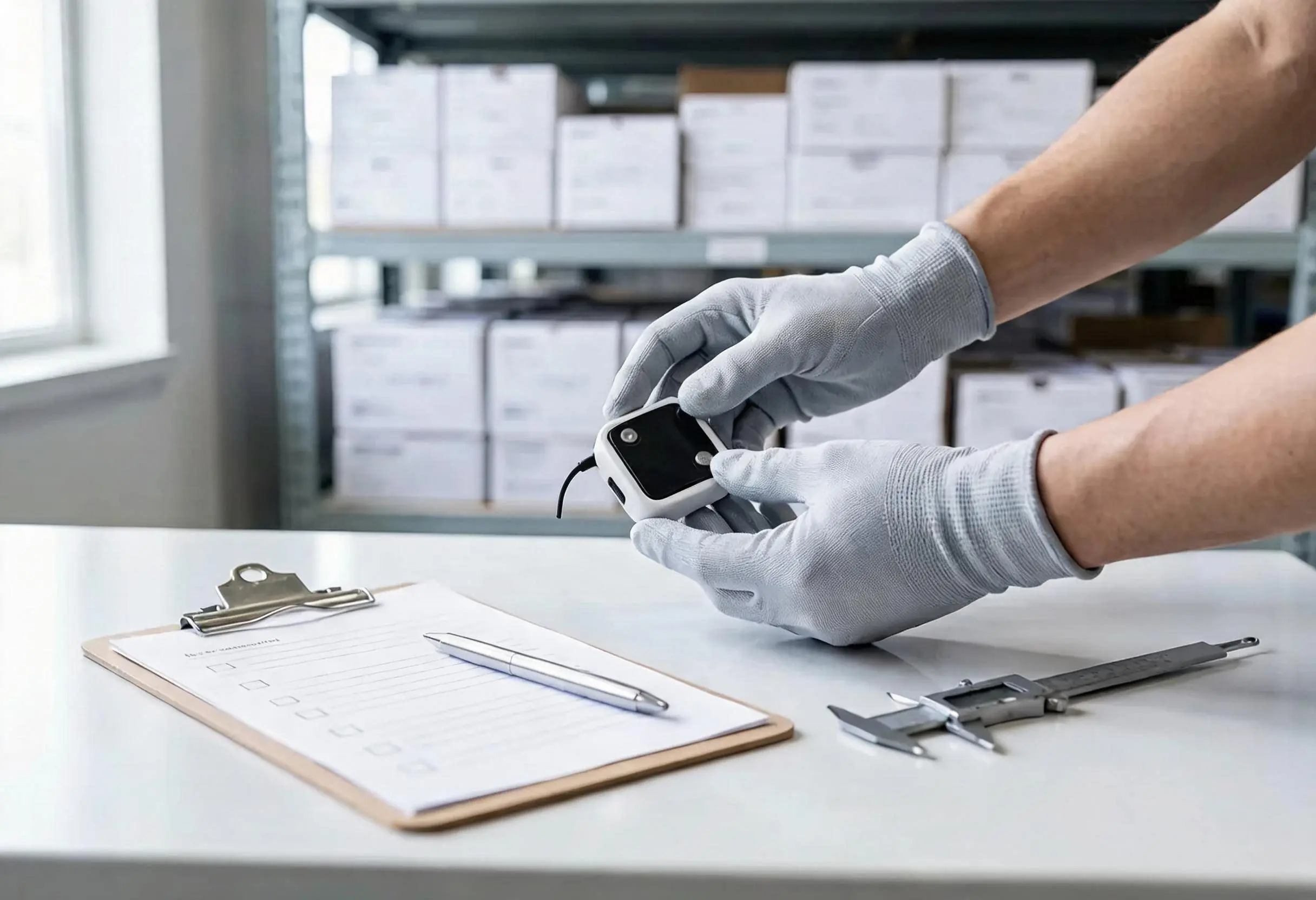
The first hundred orders ran clean. Your ad set finally found a winner, and the cash register was humming. Then the one-star reviews started rolling in: “not as described,” “arrived broken,” “wrong color.” Here’s the part nobody warns you about with pre-shipment inspection for dropshipping: you never touched that product, your supplier is six thousand miles away, but the brand is yours and the fallout lands on your lap.
A defect rate you can’t see is draining margin you thought was safe. The fix isn’t a better creative. It’s a gate: one quality checkpoint between “supplier says it’s done” and “customer opens the box.”
This guide builds that gate with you: an AQL level for a 200-unit reorder, a copy-paste checklist, the five defects that sink stores, the cost math of QC versus returns, and a 30-day launch plan. By the end, you’ll know exactly where to put the net.
Key takeaways
- A pre-shipment inspection (PSI) is a per-order quality gate run after you’ve chosen a supplier: the step most guides confuse with supplier vetting, which happens before you buy.
- Dropshipping’s average return rate is 16–20% (dojobusiness.com), roughly double traditional ecommerce, and about 60% of returns trace to fit, quality, or “not as described” (dropship.it).
- Inspect at AQL 2.5 (Major) and sample 50–200 units per batch: the same Level II standard used for a 10,000-box import, scaled to your order.
- A real-world seller cut returns from 18% to single digits after adding PSI (dropshipchinapro.com): prevention beats refunds by 20–50% (pbfulfill.com).
- You don’t have to build it alone: a Dongguan fulfillment partner can run PSI and photo-document evidence, covered in the launch plan.
What Is Pre-Shipment Inspection (PSI) in Dropshipping?
Pre-shipment inspection is exactly what it sounds like: someone physically checks your product before it leaves the factory, while you still hold use to reject, rework, or withhold payment. It’s your last chance to say “not this batch”: once goods are in a container, your only move is a refund.
PSI vs. supplier vetting: the stage most guides mix up
This is the most important distinction: and the one most “dropshipping QC” guides blur.
Supplier vetting is step zero: the background check you run before you commit: visiting the factory, checking licenses, ordering samples, reading reviews, spotting red flags. That work belongs to the sourcing phase; our guide to vetting and choosing suppliers covers the full process.
PSI is step infinity-minus-one: it happens after you’ve picked a supplier and placed an order. Even a vetted factory ships a bad batch now and then. Vetting says the supplier is capable; PSI says this batch is good. Don’t skip the gate by assuming “I vetted them, so I’m safe.”
PSI in one sentence: A documented check of a finished production batch: appearance, function, measurements, packaging, and compliance: performed before you pay the balance and release the goods to ship.
What a PSI actually checks
A proper inspection is never “eyeball it and hope.” It covers six dimensions, all checkable on a small sample:
- Appearance & workmanship: scratches, dents, stains, loose stitching, mold marks, print misalignment.
- Function & performance: does the thing do the thing? Buttons, battery, charging, app pairing, load capacity.
- Dimensions, size & color accuracy: measured against your spec sheet, not the supplier’s.
- Accessories & completeness: cables, manuals, screws, gift boxes all present and correct.
- Packaging & shipping readiness: will it survive the journey, and does the unboxing match your brand?
- Labels, manuals & compliance: country-of-origin tags, voltage marks, safety warnings, and the sneaky stuff below.
If you’re new to dropshipping, read how to start a dropshipping business first: but once you’re selling, this checklist is the core of how to quality check dropshipping products.
Why Dropshipping Needs QC More Than Traditional Retail
Plenty of first-time dropshippers figure the factory owns quality, so why should they lose sleep? Four things make that a genuinely expensive shrug.
The information gap
In traditional retail you handle inventory: you see it, test it, reject the ugly ones. In dropshipping you never do. The dropshipping model removes you from all of that, which is exactly why the gap has to be closed another way. Your only input is a customer photo, and by then the review is public. A dropshipping quality inspection exists because you’ve removed yourself from the warehouse; that removal is the whole risk.
Distance = no do-overs
When a defect surfaces after shipping, your use is gone and “send it back” costs more than the item. PSI flips that: you inspect before the balance payment, so a bad batch becomes a rework request, not a chargeback.
You are the brand image
The customer doesn’t know or care that a factory made the mistake: the box has your logo, the review names your store. A seller I’ll call Priya learned this: she ran small Bluetooth accessories through a Shenzhen trader, and her first 300 units shipped uninspected. Eleven came back “won’t charge”: counterfeit cells identical to the good ones. Her rating dropped 4.8 to 4.2 in three weeks, and conversions never recovered. A 30-minute function test on a 50-unit sample would have caught all of them.
The numbers
The data backs the gut feeling: dropshipping’s average return rate is 16–20% versus 8–12% for traditional ecommerce (dojobusiness.com), with apparel at 25–40% and electronics 8–12% (dojobusiness.com). Roughly 60% of returns trace to fit, quality, or “not as described” (dropship.it): exactly what a PSI addresses.
Scale it up: U.S. merchants eat about $400 billion a year in returns, and 75% expect free returns (dropship.it). Locally fulfilled orders see 40% fewer returns than cross-border ones (dojobusiness.com): partly because local partners inspect before shipping. A quality gate is the closest thing a cross-border seller has to that 40% advantage. Sit with that for a second: roughly a third of online returns are problems a 30-minute sample check could have caught cold.
If returns are nibbling at your margin, the fastest win is a simple gate. Grab the copy-paste checklist below and you’ll have a tool to hand a supplier this week.
AQL Sampling, Explained Simply (No Jargon)
“Sampling” sounds like cutting corners. It’s the opposite: the internationally standardized way to check a lot without opening every box, while still knowing your risk. The standard is AQL, and without the jargon it’s almost friendly.
What is AQL?
AQL stands for Acceptance Quality Limit: the worst defect rate you’ll accept in a batch and still ship it. Think of it as your tolerance for “oops.”
Three defect classes: the part sellers routinely get wrong:
- Critical (0): Anything dangerous or illegal: shock hazard, missing safety label, wrong voltage. Your AQL for critical is zero. One unit fails, the whole batch fails.
- Major (2.5): Defects a customer would return: broken function, wrong color, visible damage, missing part. Start here: AQL 2.5.
- Minor (4.0): Cosmetic nitpicks: a tiny scuff, slight label misprint. AQL 4.0 is reasonable.
So “we inspect to AQL 2.5 Major” means: a few major defects in the sample are acceptable, but beyond that the batch is rejected. Simple as that.
How many units should you inspect?
For dropshipping AQL sampling at AQL 2.5 Major (Level II), most B2B guides hand you a table built for a 10,000-box shipment: but the same ISO 2859-1 standard scales down cleanly. The four sample sizes you’ll use are 50, 80, 125, and 200.
| Your batch size | Units to inspect | If Major defects found (AQL 2.5) | Verdict |
|---|---|---|---|
| 26–50 units | 8 | 1 or more | Reject lot |
| 51–90 units | 13 | 1 | Reject lot |
| 91–150 units | 20 | 1 | Reject lot |
| 151–280 units | 32 | 2 | Reject lot |
| 281–500 units | 50 | 3 | Reject lot |
| 501–1,200 units | 80 | 5 | Reject lot |
| 1,201–3,200 units | 125 | 7 | Reject lot |
| 3,201–10,000 units | 200 | 10 | Reject lot |
The bottom row is what a container importer uses: 200 units from 10,000 gives ~95% confidence at AQL 2.5 (cloudspects.com). As a dropshipper you’ll live in the 50–200 range, which easily catches a systemic problem.
Random sampling rules
A hand-picked sample is worthless: the supplier will show you the pretty ones. Pull randomly from the top, middle, and bottom of multiple cartons, mix your variants, and document which cartons you pulled. That’s the difference between “we checked” and “we have evidence.”
Your Pre-Shipment Inspection Checklist (Copy-Paste)
Here is the copy-paste pre-shipment inspection checklist covering all six dimensions, with the dropshipping-specific traps called out — paste it into a doc, screenshot it, and send it to a supplier or inspector this week.
Appearance & workmanship
- ☐ No scratches, dents, stains, or scuffs on visible surfaces
- ☐ Stitching, seams, and glue lines are clean and even
- ☐ Print, logo, and engraving are aligned and correct
- ☐ No mold marks, flash, or burrs on plastic/metal parts
- ☐ Same finish across all sampled units (no “good unit, bad unit” mix)
Function & performance
- ☐ Every function works on every sampled unit (buttons, zippers, hinges)
- ☐ Electronics power on, charge, and hold stated battery
- ☐ App pairing / Bluetooth / Wi-Fi connects and stays connected
- ☐ Load/weight/capacity tested against spec (don’t trust the listing)
- ☐ No abnormal heat, noise, or smell during operation
Dimensions, size & color accuracy
- ☐ Measured dimensions match your spec sheet within tolerance
- ☐ Color matches the approved sample under natural light (not factory fluorescents)
- ☐ Size grading correct across the variant range (S/M/L actually differ)
- ☐ Weight within expected range (a cheap substitution shows up here)
Accessories & completeness
- ☐ Every listed accessory present: cable, adapter, manual, screws, warranty card
- ☐ Accessory specs match (right plug type, right cable length)
- ☐ Weighing method: weigh a complete sealed unit, then weigh 10–20 random sealed units. A unit light by the accessory’s weight is almost certainly missing a part (techtraq.com). This catches missing items even inside sealed boxes you can’t open.
Packaging & shipping readiness
- ☐ Inner protection (bubble, foam, insert) actually cushions the product
- ☐ Master carton survives a drop test from ~1 meter (do this on one carton)
- ☐ No crushed corners, weak tape, or loose fill that lets the product rattle
- ☐ Unboxing matches your brand promise
One caution: custom packaging is part of your quality story, but not a substitute for inspection. A beautiful mailer around a defective unit is still a refund. If you’re weighing packaging versus QC first, our custom packaging guide makes the deeper case — do both, in that order.
Labels, manuals & compliance red flags
- ☐ Country of origin, voltage, and safety marks present and correct
- ☐ Manual language matches your market (don’t ship English-market goods with Mandarin-only docs)
- ☐ Compliance red flag: inspect every insert and QR code. Some suppliers slip in competitor coupons, counterfeit cards, or even gambling/ad QR codes (techtraq.com). A QR code that points where it shouldn’t is a batch-killing defect regardless of product quality.
- ☐ No unlicensed IP, logos, or characters you didn’t authorize
The 5 Most Common Dropshipping Defect Types (and How to Catch Each)
You can’t inspect for everything, but you can inspect for the five things behind most returns — the cost each carries and the PSI move that catches it.
| Defect type | Why it drives returns | How PSI catches it |
|---|---|---|
| Wrong variant / color / size | “Wrong item” review tanks the listing | Lay sampled variants side by side; confirm each barcode maps |
| Cosmetic damage & scratches | Reads as “arrived broken” even if it works | Unwrap a few units; run the appearance checklist |
| Functional failure | Automatic 1-star, often a chargeback | Power on, charge, run through primary use case |
| Missing accessories / parts | Product fine but unusable → comes back | Weighing method finds missing items in sealed boxes |
| Packaging unsuitable for transit | Pristine product rendered “arrived broken” | Drop test one carton; check inner protection contacts product |
1. Wrong variant, color, or size. The silent killer of apparel and multi-SKU stores. Devin ran a minimalist apparel brand with a charcoal-gray hoodie as the hero. One reorder came back with roughly 1 in 8 units actually heather-gray — a SKU-mapping slip. Customers ordered “charcoal,” got “heather,” and the “wrong color” reviews tanked the listing. Cost: near-100% return on affected units plus a bruised bestseller. Catch it: lay sampled variants side by side under natural light and confirm each barcode maps to the right product — a 13-unit sample from a 90-unit batch would have caught it before one shipped.
2. Cosmetic damage & scratches. Scuffs, dents, and broken clips from careless packing. Cost: these read as “arrived broken” even when the product works — the worst avoidable refund. Catch it: the appearance checklist above, plus fully unwrapping a few units rather than trusting the outer box.
3. Functional failure. Dead batteries, failed charging, jammed mechanisms. Priya’s counterfeit-cell case (above) is the textbook example. Cost: an automatic 1-star, often a chargeback. Catch it: power on every electronic unit, charge a sample to 100%, and run it through its primary use case.
4. Missing accessories or parts. The “where’s the cable?” return. Cost: the product is fine but unusable, so it comes back. Catch it: the weighing method above finds missing items inside sealed boxes without opening every one.
5. Packaging unsuitable for transit. Boxes that arrive pancaked, inserts that do nothing. Cost: a pristine product rendered “arrived broken” by a bad box. Catch it: the drop test on one master carton plus a check that inner protection actually contacts the product.
Notice the pattern: four of these five are caught by the checklist you already have. The gate isn’t exotic — it’s disciplined.
QC vs. Returns: The Cost Math
The fastest way to avoid returns from dropshipping quality failures is a gate before the box ships. This is where inspection stops feeling like overhead and starts looking like the one line item that writes you a check instead of cashing one. Here’s the arithmetic on a realistic batch.
What a batch defect actually costs you
Reorder 200 units at $25 landed COGS — a $5,000 batch. At a 15% defect rate (within the 16–20% average), 30 bad units reach customers. Each return burns roughly $53 beyond the $25 refund: ~$12 shipping, ~$8 ad spend, ~$3 repack, ~$5 service and a likely 1-star. Thirty returns = $1,590 in hard losses, plus rating damage that suppresses future sales.
What good QC costs
- DIY / fly-and-check: your flight, hotel, days on the ground. Realistic only if you’re already in Asia or ordering at volume. Hard to scale.
- Third-party inspector: roughly $200–300 per visit (dropsure.com, tetrainspection.com), plus travel to the factory. Ideal for high-ticket or private-label goods.
- Fulfillment partner with built-in QC: often folded into per-order handling, so incremental cost per batch is small or zero.
ROI — prevention pennies beat refund dollars
Spend ~$250 to inspect that batch and you avoid ~$1,590 in direct losses plus the rating hit — a 6:1 return on the inspection alone. Across a year of reorders, sellers who add inspection report refund drops of 20–50% (pbfulfill.com).
Maya’s store is the clean example: a home-organization gadget at an 18% return rate — “felt cheap,” “arrived with cracks.” After a PSI gate (appearance, drop test, function check on a 50-unit sample), returns fell to single digits (dropshipchinapro.com). She changed nothing else. Others took structural defects from 12% to 2% (chinasourcingagent.com) and refunds from 6–8% below 0.5% (gp-fulfillment.com). The pattern holds.
How to Actually Do It: 3 Options
A checklist sitting in your Google Doc inspects nothing. Somebody has to actually run the gate — and you’ve got three ways to make that happen.
Option A — DIY / fly-and-check
You (or a trusted hire) inspect in person at the factory. Best for: very high-ticket goods or first runs. Worst for: scaling — you can’t fly to Yiwu every two weeks, and your time is worth more than counting screws. Treat DIY as a launch tool, not a system.
Option B — Third-party inspector
You hire a local firm (QIMA, V-Trust, or regional equivalents) to send a checker. Cost runs about $200–300 per inspection (dropsure.com, tetrainspection.com, chinasourcingagent.com). Best for: private-label or higher-AOV products where one bad batch is painful. Worst for: high-frequency, low-AOV reorders where the fee eats margin, or sellers wanting evidence in fulfillment rather than a PDF.
Option C — One-stop fulfillment partner
The path most growth-stage stores land on. A partner rolls sourcing, pre-shipment QC, custom packaging, and fulfillment into one pipeline. Near the factories (Dropioneer is in Dongguan with local staff who visit and inspect), they run PSI on your behalf before goods enter fulfillment — and photo/video-document each batch as evidence for a customer, platform, or your records.
| Feature | Option A: DIY | Option B: 3rd-party | Option C: Fulfillment partner |
|---|---|---|---|
| Cost per batch | High (travel + time) | ~$200–300 | Low / bundled |
| Scales with volume? | No | Partially | Yes |
| Evidence trail | Your photos | Inspector report | Photos + video + system records |
| Handles packing & shipping? | You | No | Yes, integrated |
| Best for | Launch / high-ticket | Private label | Growth-stage scaling |
If you want a partner to run the whole gate for you, our pre-shipment inspection service lays out exactly how the sourcing-to-QC-to-fulfillment chain works — including the photo-documented evidence step that turns “I think it’s fine” into “here’s the proof.”
Your 30-Day Pre-Shipment QC Launch Plan
You don’t need a quality department — just four weeks and the willingness to slow one reorder.
Week 1 — Define the spec. For every SKU, write the non-negotiables: dimensions, color references (Pantone or photo), function checklist, required accessories, packaging standard. If you can’t describe “good,” you can’t inspect for it.
Week 2 — Archive a golden unit. Pull one perfect unit and photograph it from every angle. Every future inspection compares against this, not memory — the highest-use hour you’ll spend.
Week 3 — Set your AQL and pick a method. Lock in AQL 2.5 Major / 4.0 Minor and decide who inspects: you, a third party, or a partner. Match the method to your order frequency and AOV.
Week 4 — Run your first PSI and close the loop. Inspect the next batch against the checklist, document with photos, and feed findings back to the supplier. An early rejected batch teaches the factory your standard; silence teaches them you have none.
Don’t want to build this from zero? A Dongguan fulfillment partner like Dropioneer can run the PSI and photo-document evidence for you, so you stay focused on marketing while the gate runs itself — the difference between “I should probably inspect” and “it’s already happening every batch.”
FAQs
What is quality control in dropshipping?
It’s quality control in dropshipping in practice: the gap between what your listing promised and what the customer actually unboxes — appearance, function, measurements, accessories, packaging, compliance. Pre-shipment inspection is the highest-use version: you check the finished batch before it leaves the factory, not after a one-star review tells you it was wrong.
How much does pre-shipment inspection cost?
A third-party inspector typically charges $200–300 per visit (dropsure.com, tetrainspection.com); DIY costs your travel and time, while a fulfillment partner often bundles QC into per-order handling. Against $50+ per defective unit in returns, inspection pays for itself on the first caught batch.
Can I do QC if I source from AliExpress or 1688?
Yes, but it’s harder because those platforms optimize for small, fragmented orders rather than batch production. Consolidate through a fulfillment partner or agent who inspects the batch before forwarding — or graduate to a dedicated supplier once a product proves out, then apply this guide’s PSI gate.
What AQL level should a dropshipper use?
Start at AQL 2.5 for Major and AQL 4.0 for Minor, with zero tolerance for Critical (safety/legal) defects. This matches Level II sampling used even on 10,000-unit imports (cloudspects.com) and scales to the 50–200-unit samples most dropshippers run.
How is PSI different from supplier vetting?
Supplier vetting is the background check you do before choosing a factory — licenses, samples, track record. PSI is the per-batch check you do after ordering, to confirm this specific production run is good. Vetting picks a capable partner; inspection confirms the partner’s latest batch. For the full vetting process, see our supplier sourcing guide.
Does custom packaging replace QC?
No. Custom packaging protects the product in transit and shapes the unboxing, but a beautiful box around a defective unit is still a refund. Packaging is one part of quality control, not a replacement for it. We lay out the deeper case in our custom packaging guide.
Conclusion
Dropshipping removes you from the warehouse — that’s the efficiency and the risk. The stores that scale are the ones that rebuild a window into quality without rebuilding a warehouse. A pre-shipment inspection is that window: a documented check that catches the wrong color, dead battery, missing cable, and crushed box before they become one-star reviews.
You don’t need to overthink it. Set AQL 2.5, copy the checklist, run your first PSI in 30 days, and feed results back. Whether you build it or hand the gate to a partner, the principle is the same: stop the bad units before they leave the factory.
Stop bad batches before they leave China
Our pre-shipment inspection service wraps sourcing, strict QC, custom packaging, and fulfillment into one pipeline — with photo-documented evidence on every batch.
{ “@context”: “https://schema.org”, “@type”: “Article”, “headline”: “Pre-Shipment Inspection for Dropshipping: Catch Bad Batches”, “description”: “Learn pre-shipment inspection for dropshipping: AQL sampling, a copy-paste defect checklist, the five most common defects, the QC vs returns cost math, and a 30-day launch plan.”, “image”: “https://dropioneer.com/wp-content/uploads/2024/07/Dropioneer_logo_R-11.webp”, “datePublished”: “2026-07-23”, “dateModified”: “2026-07-23”, “author”: { “@type”: “Organization”, “name”: “Dropioneer”, “url”: “https://dropioneer.com/”, “@id”: “https://dropioneer.com/#organization” }, “publisher”: { “@type”: “Organization”, “name”: “Dropioneer”, “logo”: { “@type”: “ImageObject”, “url”: “https://dropioneer.com/wp-content/uploads/2024/07/Dropioneer_logo_R-11.webp” }, “@id”: “https://dropioneer.com/#organization” }, “mainEntityOfPage”: { “@type”: “WebPage”, “@id”: “https://dropioneer.com/blog/pre-shipment-inspection-for-dropshipping/” }, “wordCount”: 3500 } { “@context”: “https://schema.org”, “@type”: “BreadcrumbList”, “itemListElement”: [ { “@type”: “ListItem”, “position”: 1, “name”: “Home”, “item”: “https://dropioneer.com/” }, { “@type”: “ListItem”, “position”: 2, “name”: “Blog”, “item”: “https://dropioneer.com/blog/” }, { “@type”: “ListItem”, “position”: 3, “name”: “Pre-Shipment Inspection for Dropshipping”, “item”: “https://dropioneer.com/blog/pre-shipment-inspection-for-dropshipping/” } ] } { “@context”: “https://schema.org”, “@type”: “FAQPage”, “mainEntity”: [ { “@type”: “Question”, “name”: “What is quality control in dropshipping?”, “acceptedAnswer”: { “@type”: “Answer”, “text”: “It’s the gap between what your listing promised and what the customer actually unboxes — appearance, function, measurements, accessories, packaging, compliance. Pre-shipment inspection is the highest-use version: you check the finished batch before it leaves the factory, not after a one-star review tells you it was wrong.” } }, { “@type”: “Question”, “name”: “How much does pre-shipment inspection cost?”, “acceptedAnswer”: { “@type”: “Answer”, “text”: “A third-party inspector typically charges $200-300 per visit (dropsure.com, tetrainspection.com); DIY costs your travel and time, while a fulfillment partner often bundles QC into per-order handling. Against $50+ per defective unit in returns, inspection pays for itself on the first caught batch.” } }, { “@type”: “Question”, “name”: “Can I do QC if I source from AliExpress or 1688?”, “acceptedAnswer”: { “@type”: “Answer”, “text”: “Yes, but it’s harder because those platforms optimize for small, fragmented orders rather than batch production. Consolidate through a fulfillment partner or agent who inspects the batch before forwarding — or graduate to a dedicated supplier once a product proves out, then apply this guide’s PSI gate.” } }, { “@type”: “Question”, “name”: “What AQL level should a dropshipper use?”, “acceptedAnswer”: { “@type”: “Answer”, “text”: “Start at AQL 2.5 for Major and AQL 4.0 for Minor, with zero tolerance for Critical (safety/legal) defects. This matches Level II sampling used even on 10,000-unit imports (cloudspects.com) and scales to the 50-200-unit samples most dropshippers run.” } }, { “@type”: “Question”, “name”: “How is PSI different from supplier vetting?”, “acceptedAnswer”: { “@type”: “Answer”, “text”: “Supplier vetting is the background check you do before choosing a factory — licenses, samples, track record. PSI is the per-batch check you do after ordering, to confirm this specific production run is good. Vetting picks a capable partner; inspection confirms the partner’s latest batch. For the full vetting process, see our supplier sourcing guide.” } }, { “@type”: “Question”, “name”: “Does custom packaging replace QC?”, “acceptedAnswer”: { “@type”: “Answer”, “text”: “No. Custom packaging protects the product in transit and shapes the unboxing, but a beautiful box around a defective unit is still a refund. Packaging is one part of quality control, not a replacement for it. We lay out the deeper case in our custom packaging guide.” } } ] } { “@context”: “https://schema.org”, “@type”: “Organization”, “@id”: “https://dropioneer.com/#organization”, “name”: “Dropioneer”, “url”: “https://dropioneer.com/”, “logo”: “https://dropioneer.com/wp-content/uploads/2024/07/Dropioneer_logo_R-11.webp”, “address”: { “@type”: “PostalAddress”, “streetAddress”: “Dongxiang Industrial Road, Zhongtang Town”, “addressLocality”: “Dongguan City”, “addressCountry”: “CN” } }
Dropshipping Quality Control: What It Actually Covers
Dropshipping quality control is not the same as factory quality control, because the seller rarely sees the goods. It is a chain of checks placed at the points where defects can still be caught before the customer does, and each point costs something different.
| Checkpoint | What it catches | When it is worth paying for |
|---|---|---|
| Supplier screening | Factories that cannot hold a spec at all. | Always — the cheapest control is choosing a supplier you will not have to police. |
| Sample approval | Colour, material and dimensional drift before volume starts. | Before any first order, and again after any tooling or material change. |
| In-line check | Process drift while the batch is still running. | Long runs where scrapping a whole batch is expensive. |
| Pre-shipment inspection | Finished-goods defects: function, appearance, packaging, labelling. | The default control point for dropshipping — it happens while the goods are still at the factory. |
| Inbound check at the warehouse | Quantity errors, transit damage, mixed SKUs. | When you hold stock, or when the 3PL repacks before dispatch. |
How sampling is actually specified
Pre-shipment inspection normally uses an acceptance sampling plan rather than a 100% check, because checking everything is often more expensive than the defects it prevents. The internationally used framework is ISO 2859-1 (the same scheme published in the US as ANSI/ASQ Z1.4), which pairs a lot size with a sample size and an acceptance number for a chosen AQL.
| Term | What it means |
|---|---|
| AQL | Acceptable Quality Limit — the worst defect rate you are willing to accept as normal. Commonly 0 for critical defects, 2.5 for major and 4.0 for minor. |
| Critical defect | A defect that makes the product unsafe or illegal to sell. Accepting zero of these is a business decision, not a statistical one. |
| Major defect | A defect that makes the product unusable or unsellable as described. |
| Minor defect | A cosmetic deviation that does not affect function. |
What to write into the inspection brief
- Defect classification for your own product — an inspector cannot guess which scratches are major and which are minor.
- Measurement method and the gauge used, so a borderline part is judged the same way twice.
- A functional test where the product has one, not only a visual check.
- Photo evidence of every defect found, referenced to the carton it came from.
- What happens on failure — rework, sort, or reject — agreed before the inspection, not after.
The reason dropshipping quality control fails in practice is rarely the inspector. It is that the brief was vague, so the pass/fail line moved with whoever was looking — and the customer found out first.
Guide index: related reading
- 3PL For Dropshipping: The Complete Guide To Overseas Warehousing
- How to Prevent Stockouts in Dropshipping Without Holding Inventory
- Dropshipping Fulfillment: How It Works, Costs, SLAs & How to Choose a 3PL (2026
- Product Photography and Promotional Media for Dropshipping: Building Visual Asse
- How to Start a Dropshipping Business in 2026: 10 Steps to a Store That Scales Pa
- Top 6 Products Gaining Momentum Among Dropshipping Sellers
- Why Is My Dropshipping Supplier Sending Wrong Items? (And How to Fix It in 2026)
- Why Do Dropshipping Customers Keep Asking for Refunds? (And How to Fix Your Refu
- Why Are My Dropshipping Orders Always Late? (Fixing Shipping Delays in 2026)
- Why Is My Dropshipping Store Not Making Money? (And How to Fix It in 2026)
- Is Dropshipping Profitable in 2026? A Real Numbers Breakdown