

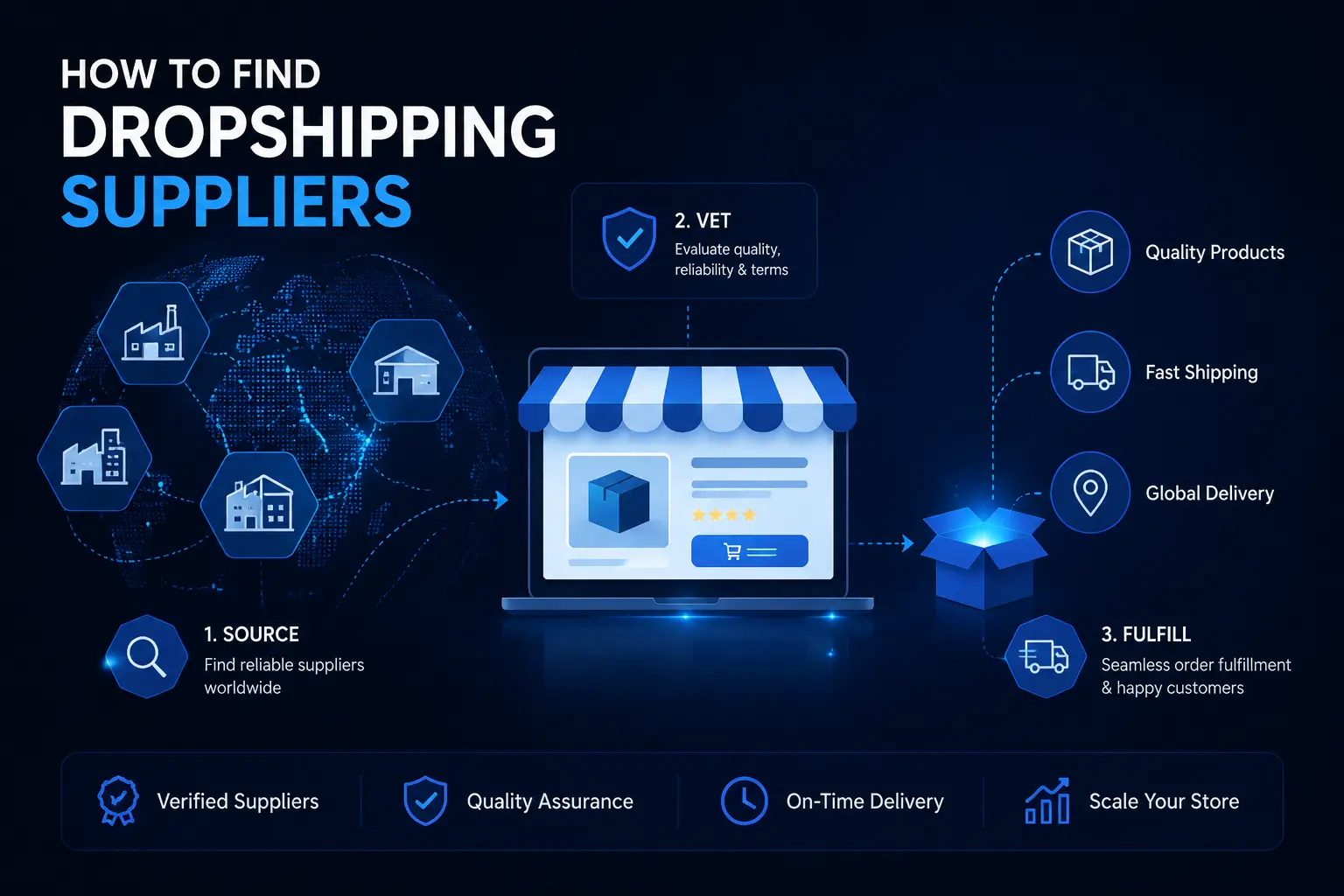
Your supplier is not a vendor you ping when stock runs low. Your supplier is the invisible half of your brand — they decide your product quality, your shipping speed, your unboxing experience, and ultimately your refund rate. Pick wrong, and you spend your ad budget buying angry reviews. Pick right, and sourcing becomes the engine that lets a store scale past its first fragile months.
If you worked through our guide on how to start a dropshipping business, you already know the model. This is the practical playbook for how to find dropshipping suppliers that actually hold up once real orders start flowing — not just the ones that look good in a directory.
The dropshipping market is on track to be valued at roughly USD 1.25 trillion by 2030, which means more tools, directories, and sourcing routes than ever. The hard part was never “finding a supplier.” It was finding one you can trust with your customers’ experience at 50 orders a day. That is what this guide is about.
Why your supplier is your business partner, not a line item
A single bad supplier can undo months of marketing. Slow shipping turns into chargebacks. Inconsistent quality spikes your return rate. A communication blackout leaves you unable to answer a customer who already paid. When you source through a partner that also handles product sourcing and procurement, quality checks, custom packaging, and fulfillment under one roof, those failure points collapse into one accountable relationship instead of four vendors pointing at each other.
The stores that survive past month six treat sourcing as a core competency, not an afterthought. They score suppliers, they test before they trust, and they keep backups warm. The rest treat it as a one-time checkbox — and it shows in their reviews.
Where to find dropshipping suppliers
There are more entry points than most beginners realize. Each fits a different stage of your store.
Vetted supplier directories. Platforms like SaleHoo, Zendrop, and Spocket pre-screen suppliers so you skip hours of due diligence. SaleHoo alone lists over 8,000 verified suppliers with built-in market research. The trade-off is a subscription fee and, on some, a margin premium. Use directories when you want structured options fast and you are still shaping your niche. For the bigger picture, Shopify’s guide to dropshipping lays out the model end to end.
Dropshipping apps. Spocket, AutoDS, DSers, and similar apps plug directly into Shopify and route orders to integrated suppliers. They are the easiest on-ramp for a beginner because setup and order routing are handled for you. The cost is less control over branding and thinner margins.
Global marketplaces. AliExpress is the classic testing ground: one unit, no MOQ, English interface, international checkout. Alibaba is the B2B side — negotiate bulk pricing, request custom manufacturing, and filter by “Trade Assurance” and “Verified Supplier.” 1688 is China’s domestic wholesale marketplace with the lowest prices (1688.com), but it is Chinese-language, needs a local payment method, and will not ship single units abroad without help.
Sourcing agents. A China sourcing agent buys from 1688 or factories on your behalf, inspects every item, repackages it with your branding, and ships internationally. They are the bridge that turns 1688’s wholesale pricing into a dropshippable workflow.
Trade shows and direct manufacturers. ASD Market Week, the Canton Fair, and White Label World Expo put you face-to-face with suppliers who care about serious retail partnerships. And once you are doing 50+ units a month of a specific item, contacting the manufacturer directly often unlocks better pricing and priority fulfillment.
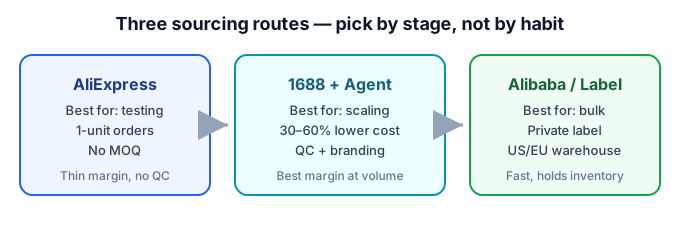
AliExpress vs 1688 + agent vs Alibaba: when to use which
This is the decision that quietly defines your margin. A product that retails for $18.50 on AliExpress often costs $6.80 on 1688 — nearly triple the unit margin before ad spend and platform fees. That gap is the AliExpress middleman tax, and it compounds on every order.
- AliExpress wins on simplicity. Zero setup, single-unit ordering, familiar interface. Use it to test product ideas with low commitment. The downside: thin 15–25% net margins, no quality control, AliExpress branding on the parcel, and unreliable shipping estimates.
- 1688 + a sourcing agent wins on margin once you have validated demand. You pay wholesale plus a 5–10% agent fee and real shipping, but you also get QC photos before shipment and branded repackaging. Most apparel, accessories, and home goods see 30–60% lower product cost versus AliExpress.
- Alibaba wholesale + a US/EU warehouse wins on speed and consistency for proven products. You commit to dozens or hundreds of units, clear one formal customs entry, and your last-mile delivery drops to a few days. You take on inventory risk, but you recover most of the margin that per-parcel duty erodes.
The smart path most profitable stores follow: test on AliExpress, scale proven winners through 1688 + agent, and move bulk private-label volume to Alibaba with local warehousing.
How to vet a supplier before you commit
Finding suppliers is the easy part. Vetting is the work. Run this checklist before signing anything.
1. Order product samples. Never list a product you have not physically held. Order 2–3 samples and judge material quality, accuracy versus the listing photos, packaging presentation, and actual delivery time. A seller “Maya” we spoke with tested three suppliers for the same yoga mat; only one’s sample matched the photos, and it became her sole source for two years.
2. Measure communication speed. Send a test inquiry and time the reply. Reliable suppliers respond within one business day. If they ghost you before you are a customer, imagine the silence after you are.
3. Verify credentials. Request the business license, tax ID, and any certifications your category requires. A legitimate supplier provides these without hesitation. For China sourcing, ask how they handle HTS classification and customs docs — their answer (or hesitation) tells you how smooth shipments will be.
4. Place a small test batch. Samples can be cherry-picked. A 5–10 unit test order reveals real-world processing time, tracking accuracy, and packaging quality. Stress-test communication: ask a detailed question, report a minor issue, and watch how they handle small pressure.
5. Score them 1–10. Rate each supplier on speed, quality, communication, inventory accuracy, and pricing transparency. Drop anyone scoring below 7 in any category. One serious issue is enough to pause — you do not need every red flag to be at risk.
Mini-story — Skip the sample at your own peril
A seller “Devin” skipped the sample step to save a week and listed a wireless earbud he had only seen in photos. The first batch arrived with mismatched colors and a 12% defect rate; by the time he swapped suppliers, he had eaten $2,400 in refunds. The sample week he skipped cost him a month.
Negotiating terms that protect your margin
Vetting gets you to “trustworthy.” Negotiation gets you to “profitable.”
- Price at volume. Always ask what pricing looks like at 50, 100, and 500 units. The answer tells you your scaling ceiling.
- Lock MOQ and lead time in writing. Whatever is agreed over chat has a habit of changing once the invoice appears. Get it in the contract.
- Returns and defects. Clarify who pays return shipping, how defective items are handled, and the restocking process. These details hit your margin on every return.
- Tariffs and duties. In 2026, duty often applies per parcel, which can erase a third of the old margin on single-parcel fulfillment. Build duty and a broker or entry fee into your unit math, and lean on bulk import to a local warehouse when volume justifies it.
- Compliance docs. For regulated categories, ask upfront for the documents that prove the product can clear customs and stay listed.
Quality control is non-negotiable
With AliExpress you never see the product before your customer does. With a proper quality check process, someone physically inspects each item for damage, defects, and wrong specifications before it ships. That single step is the difference between a refund and a repeat customer.
A real QC partner returns bad units to the factory before they ever reach your buyer. They flag wrong sizes, color drift, and packaging flaws while the order is still in the warehouse. If you are scaling, this is not optional — it is the control that keeps your star rating alive.
Custom packaging turns a parcel into a brand
Customers in 2026 expect an unboxing experience. A product in a nondescript plastic bag makes your brand look cheap; the same product in a custom box with an English manual and a thank-you note becomes a moment worth photographing.
Custom packaging lets you strip supplier branding, add your own, and create the consistency that turns one-time buyers into a label they recognize. For Maya’s yoga mats, switching from plain mailers to branded tubes lifted her repeat-purchase rate enough that she reinvested the difference into better suppliers.
Fulfillment and 3PL: closing the loop
Once your supplier list is solid, the next leverage point is fulfillment: our complete guide to 3PL for dropshipping and overseas warehousing covers how a 3PL partner closes the loop between sourcing and delivery.
Sourcing is half the job. How you ship and clear customs counts just as much as who you buy from. Once products pass QC and get packaged, they need a fulfillment path that keeps delivery promises — and for proven, higher-volume SKUs, a 3PL with local warehousing compresses last-mile time from weeks to days.
The advantage of a partner who owns sourcing, QC, packaging, and fulfillment together is continuity: one accountable team, one tracking flow, one relationship to manage instead of four. When a delivery slips, you call one number, not three.
Red flags that mean walk away
One serious issue can be enough. Watch for:
- Refusal to send samples, or a large upfront deposit before any test order
- No physical address or verifiable business information
- Vague answers like “very fast, good quality” instead of real numbers
- High-pressure “today only” pricing
- Surprise per-unit handling fees that were not in the original quote
- Fake or non-updating tracking numbers
- Blame-shifting when a mistake is demonstrably theirs
- A “manufacturer” who cannot answer basic production questions
If you see more than one, move on. There are enough legitimate suppliers that the risk is never worth it.
Build a backup supplier system
Single-supplier dependency is a business risk. One stockout or quality drop can stall revenue overnight. For your top 5–10 products — the ones driving most of your revenue — qualify 2–3 backup suppliers and send them 5–10 orders a month to keep the relationship warm. Document exact specs (photos, measurements, materials, packaging) so a switch is invisible to customers. Set triggers: if primary shipping slips past five days on 15%+ of orders, or defects hit 5%, start shifting volume.
Mini-story — The backup buffer that saved Q4
A seller “Priya” ran this system for her kitchen-gadget store. When her main supplier doubled lead times before a holiday peak, her backup was already warmed and absorbed 40% of volume with zero customer-facing disruption. That buffer is what kept her promotion profitable.
Your 30-day sourcing plan
A plan beats enthusiasm. Here is a 30-day arc that takes you from zero to a vetted, backed-up supply base.
- Days 1–7 — Discover. Use a directory or app to shortlist 10–15 candidates per product. Reverse-image-search competitor listings to find original factories. Read this month’s reviews, not three-year-old ones.
- Days 8–14 — Sample. Order 2–3 samples from your top 3–4 candidates per product. Photograph and measure against the listing. Time the delivery.
- Days 15–21 — Vet. Send a test inquiry, request credentials, and place a 5–10 unit test batch from your leading candidate. Score 1–10 on the five dimensions.
- Days 22–27 — Negotiate. Lock MOQ, lead time, price at volume, and return terms in writing. Confirm duty and compliance handling.
- Days 28–30 — Harden. Qualify one backup supplier per top product and send a small warm-up order. Document specs. Confirm your sourcing and procurement workflow is repeatable before you raise ad spend.
Frequently asked questions
How do I find dropshipping suppliers without getting scammed?
Start with a vetted directory or a well-reviewed app, then verify independently: order samples, request business credentials, place a small test batch, and score each supplier 1–10 on speed, quality, communication, inventory, and pricing. Walk away from anyone refusing samples, hiding an address, or pressuring “today only” deals.
Is AliExpress or a sourcing agent better?
AliExpress is best for low-commitment testing — one unit, no MOQ, instant setup. A China sourcing agent (often paired with 1688) is better once demand is proven, cutting product cost 30–60% and adding QC photos plus branded repackaging. Most growing stores use both at different stages.
Should I use one supplier or several?
One supplier is simpler to manage, but keeping at least one qualified backup per winning product protects you from stockouts, price changes, and slow routes. For your top revenue products, run 2–3 warmed backups.
What red flags show a bad supplier?
Refusing samples, no verifiable address, vague answers instead of numbers, surprise fees, fake tracking, blame-shifting, and inability to answer production questions. More than one means walk away.
When should I move from AliExpress to bulk import?
Once a product is validated at 50+ units a month, a bulk import to a US or EU warehouse recovers the margin that per-parcel duty erodes, and compresses delivery to a few days. Start with a 50–100 unit trial shipment before committing to larger volume.
Conclusion
Knowing how to find dropshipping suppliers is really knowing how to de-risk your customer’s experience before you scale. Test cheap, vet hard, negotiate in writing, and keep backups warm. And the more of that chain — sourcing, quality checks, custom packaging, fulfillment — you can hand to one accountable partner, the fewer fires you fight at 50 orders a day.
If you want sourcing, QC, branding, and fulfillment managed as a single workflow, our sourcing and procurement team builds that pipeline around your store. The suppliers are only the beginning; the system around them is what lets a store grow.
Build an accountable supply chain today
Connect with Dropioneer for China sourcing, strict quality control, branded packaging, and fast automated fulfillment.
{ “@context”: “https://schema.org”, “@type”: “Article”, “headline”: “How to Find Dropshipping Suppliers: The 2026 Sourcing Guide for Growing Stores”, “description”: “A practical 2026 guide on how to find dropshipping suppliers: where to look, how to vet them, AliExpress vs 1688 + agent vs Alibaba, red flags, and a 30-day sourcing plan.”, “author”: { “@type”: “Organization”, “name”: “Dropioneer”, “@id”: “https://dropioneer.com/#organization” }, “publisher”: { “@type”: “Organization”, “name”: “Dropioneer”, “@id”: “https://dropioneer.com/#organization” }, “datePublished”: “2026-07-23”, “dateModified”: “2026-07-23”, “mainEntityOfPage”: { “@type”: “WebPage”, “@id”: “https://dropioneer.com/blog/dropshipping-supplier-sourcing-guide/” } } { “@context”: “https://schema.org”, “@type”: “BreadcrumbList”, “itemListElement”: [ { “@type”: “ListItem”, “position”: 1, “name”: “Home”, “item”: “https://dropioneer.com/” }, { “@type”: “ListItem”, “position”: 2, “name”: “Blog”, “item”: “https://dropioneer.com/blog/” }, { “@type”: “ListItem”, “position”: 3, “name”: “How to Find Dropshipping Suppliers”, “item”: “https://dropioneer.com/blog/dropshipping-supplier-sourcing-guide/” } ] } { “@context”: “https://schema.org”, “@type”: “FAQPage”, “mainEntity”: [ { “@type”: “Question”, “name”: “How do I find dropshipping suppliers without getting scammed?”, “acceptedAnswer”: { “@type”: “Answer”, “text”: “Start with a vetted directory or a well-reviewed app, then verify independently: order samples, request business credentials, place a small test batch, and score each supplier 1 to 10 on speed, quality, communication, inventory, and pricing. Walk away from anyone refusing samples, hiding an address, or pressuring today-only deals.” } }, { “@type”: “Question”, “name”: “Is AliExpress or a sourcing agent better?”, “acceptedAnswer”: { “@type”: “Answer”, “text”: “AliExpress is best for low-commitment testing with one-unit orders and no MOQ. A China sourcing agent paired with 1688 is better once demand is proven, cutting product cost 30 to 60 percent and adding QC photos plus branded repackaging. Most growing stores use both at different stages.” } }, { “@type”: “Question”, “name”: “Should I use one supplier or several?”, “acceptedAnswer”: { “@type”: “Answer”, “text”: “One supplier is simpler to manage, but keeping at least one qualified backup per winning product protects you from stockouts, price changes, and slow routes. For your top revenue products, run two to three warmed backups.” } }, { “@type”: “Question”, “name”: “What red flags show a bad supplier?”, “acceptedAnswer”: { “@type”: “Answer”, “text”: “Refusing samples, no verifiable address, vague answers instead of numbers, surprise fees, fake tracking, blame-shifting, and inability to answer production questions. More than one means walk away.” } }, { “@type”: “Question”, “name”: “When should I move from AliExpress to bulk import?”, “acceptedAnswer”: { “@type”: “Answer”, “text”: “Once a product is validated at 50 plus units a month, a bulk import to a US or EU warehouse recovers the margin that per-parcel duty erodes and compresses delivery to a few days. Start with a 50 to 100 unit trial shipment before committing to larger volume.” } } ] } { “@context”: “https://schema.org”, “@type”: “Organization”, “@id”: “https://dropioneer.com/#organization”, “name”: “Dropioneer”, “url”: “https://dropioneer.com/”, “logo”: “https://dropioneer.com/wp-content/uploads/2024/07/Dropioneer_logo_R-11.webp”, “address”: { “@type”: “PostalAddress”, “streetAddress”: “Dongxiang Industrial Road, Zhongtang Town”, “addressLocality”: “Dongguan City”, “addressCountry”: “China” } }
Dropshipping Sourcing: The Three Models and What Each Costs You
Dropshipping sourcing is the decision of where the goods come from before any storefront question matters. There are three practical models, and they trade unit cost against control, lead time and cash.
| Model | How it works | What you give up |
|---|---|---|
| Domestic wholesaler or distributor | Buy from a local distributor who already holds stock. | Highest unit cost and the weakest exclusivity; easiest to start. |
| Overseas trading agent | An agent consolidates several factories and handles QA, consolidation and export paperwork. | A margin layer, plus dependence on the agent’s own quality standards. |
| Direct from factory | Contract the manufacturer directly, often OEM or ODM. | MOQ, tooling cost, longer lead time and full responsibility for quality and compliance. |
The variables that decide which model survives
- Order size and reorder rhythm — a factory MOQ only works if you can absorb it repeatedly, not once.
- Lead time the customer will tolerate — overseas production plus sea freight is measured in weeks, not days.
- Product liability and compliance — the importer of record carries the labelling and conformity obligations, whoever makes the item.
- Customisation need — if the product must be branded or modified, you are already in OEM territory.
A sourcing check before the first order
| Verify | Why it changes the deal |
|---|---|
| The legal manufacturing entity, not just the sales agent | Contracts and liability follow the entity that actually makes the goods. |
| Trade terms (which Incoterm applies) | It decides who pays freight, insurance and at which point risk transfers. |
| Payment terms and deposit | A large up-front deposit is your capital at risk, not theirs. |
| Sample and specification approval in writing | The approved sample is the reference every later batch is judged against. |
| Who handles returns and defective units | Without this, every defect becomes your cost by default. |
Sourcing and dropshipping are usually described as opposites. In practice dropshipping is a fulfilment method sitting on top of a sourcing decision, and it is the sourcing decision that sets the floor on your unit cost and your defect rate.
Deep dive
Guide index: related reading
- Sourcing & Procurement Services — agent-led sourcing for stores past the DIY stage
- Custom Packaging for Dropshipping: Boxes & Inserts — what to do once the supplier is vetted
- Pre-Shipment Inspection for Dropshipping — the QC gate before every batch ships
- Best 3PL for Dropshipping: A Comparison Framework — choosing the fulfillment partner after sourcing is solved