

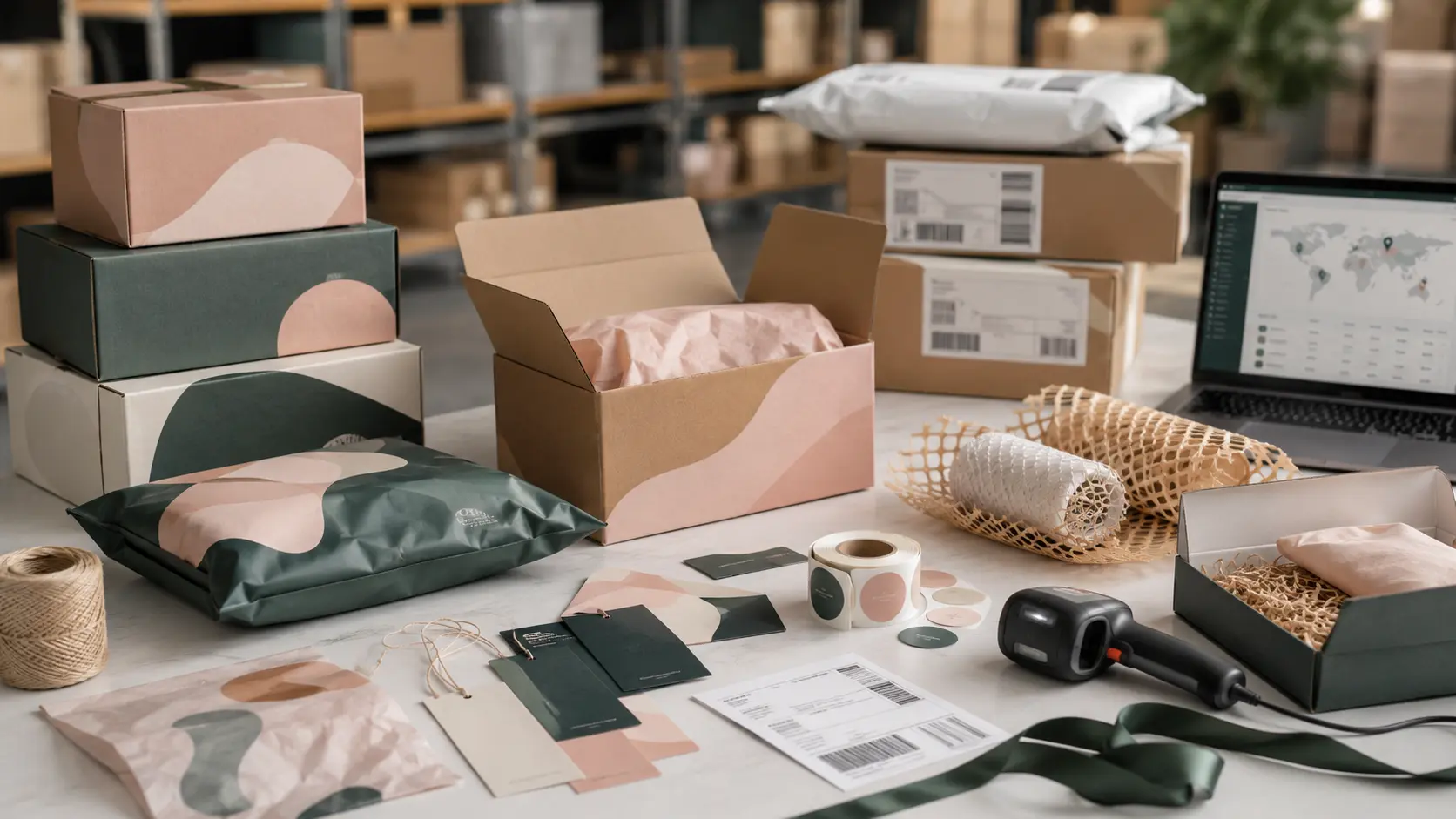
Many e-commerce merchants start their online stores by selling off-the-shelf products. While this approach allows for quick testing, it often results in customers receiving identical items shipped in generic grey poly mailers with no brand identity. This lack of professional presentation can limit customer retention and make it difficult to build long-term business value.
Why Custom Packaging Matters for Modern E-commerce
In the current e-commerce environment, customer acquisition costs are high. Relying solely on first-time buyers is rarely sustainable. Retaining existing customers through a professional unboxing experience helps improve repeat purchase rates and offset ad costs.
Using customized packaging provides three primary operational advantages:
- Brand Recognition: When a package arrives with your logo, colors, and clean typography, it looks like it came from an established company rather than a generic factory. This builds immediate customer trust.
- Reduced Shipping Damage: Standard retail boxes are often made of thin cardboard that easily crushes during international transit. Upgrading to sturdy corrugated boxes protects the product, reducing customer complaints and return requests.
- Platform Compliance: Marketplaces like TikTok Shop and Etsy have strict shipping guidelines. Branded packaging shows platform reviewers that you are a legitimate merchant, reducing the risk of account suspensions.
Common Packaging Materials for E-commerce
Before designing your packaging, you need to understand the physical materials available. Each material has distinct manufacturing costs, weight implications, and aesthetic qualities. Selecting the right option depends on your product type and budget.
| Packaging Type | Common Materials | Best For | Typical MOQs |
|---|---|---|---|
| Custom Poly Mailers | LDPE (Low-Density Polyethylene), Biodegradable cornstarch mixtures | Apparel, t-shirts, soft goods, and non-fragile boxed products | 500 – 1,000 pcs |
| Padded Bubble Mailers | Kraft paper outer with bubble wrap lining, metallic foil bags | Jewelry, cosmetics, small electronics, phone cases | 1,000 pcs |
| Corrugated Boxes | E-flute corrugated cardboard, Kraft cardboard (typically 3-layer) | Fragile goods, premium electronics, shoe boxes, high-end cosmetics | 500 pcs |
| Packaging Inserts | Art card paper (250g-350g), textured linen paper | Thank-you cards, user manuals, discount codes, QR code guides | 500 – 1,000 pcs |
The Cost of Weight: Shipping Calculations in Air Freight
In international e-commerce, most packages are shipped via air express or air mail routes. Air cargo carriers use two different metrics to calculate shipping costs: **Actual Weight** and **Volumetric (Dimensional) Weight**.
Your shipping cost is based on whichever weight is higher. The standard formula used by air freight carriers to calculate volumetric weight is:
Volumetric Weight (kg) = [Length (cm) × Width (cm) × Height (cm)] ÷ 5000 (or 6000)
For example, if you sell a lightweight item like a silk pillowcase (actual weight: 0.15 kg) and pack it in a custom rigid cardboard box measuring 30cm × 20cm × 10cm, the volumetric weight is calculated as:
(30 × 20 × 10) ÷ 5000 = 0.60 kg
In this scenario, the carrier will bill you for 0.60 kg instead of the actual 0.15 kg weight. This means your packaging choice could quadruple your shipping costs.
When planning your packaging design, aim to minimize empty space inside the box. For non-fragile items, lightweight options like custom poly mailers or soft fabric pouches are often better than rigid cardboard boxes, as they do not add unnecessary dimensional weight to your shipments.
How to Set Up Custom Packaging in China: Step-by-Step
Coordinating customized packaging requires clear collaboration between your store, your product manufacturer, and your warehouse team. Here is how the setup process works from start to finish:
Step 1: Product Sourcing and Dimension Verification
Before ordering custom packaging, you need exact physical dimensions of your product. Do not rely on estimated dimensions from online listings. Have your product sourcing partner or agent measure the item physically, including any factory retail boxes. Once the dimensions are verified, you can select the correct size for your custom mailers or boxes.
Step 2: Designing the Packaging Layout
Most packaging factories in China require professional design files, typically in vector formats like Adobe Illustrator (.AI) or CorelDRAW (.CDR). You can hire a designer to create your layout or use a dedicated brand design service. Your design should clearly specify logo placement, color codes (Pantone matching), and printing finishes (matte, glossy, or spot UV).
Step 3: Manufacturing and Samples
Once your design is finalized, the packaging files are sent to a specialized packaging manufacturer. For complex boxes, it is advisable to pay for a physical sample first. Have your agent check the sample’s thickness, printing quality, and structure. Once you approve the sample, the factory begins mass production of your packaging.
Step 4: Warehousing and Inventory Sync
After mass production is completed, the custom packaging is delivered to your fulfillment center. A professional provider stores your branded boxes and inserts in their warehouse. The inventory levels of your packaging are synced to your account dashboard, allowing you to monitor stock and reorder boxes before they run out.
Step 5: Pick, Pack, and Ship
When a customer places an order on your Shopify or WooCommerce store, the order details sync to the warehouse system. During order fulfillment, the packing staff retrieves the product from its bin, performs a quality check, places it inside your custom box, adds your thank-you card, and ships the package to the customer.
What Branded Elements Can You Add to Your Packaging?
Custom packaging involves more than just printing a logo on a cardboard box. You can combine several branded elements to create a cohesive unboxing experience:
- Branded Mailers: Custom printed poly mailers or Kraft paper envelopes are a cost-effective way to brand your shipments without adding weight. They are highly suitable for apparel and accessories.
- Custom Tissue Paper: Wrapping products in custom printed tissue paper adds a premium touch. It keeps products secure inside the box and improves presentation at a low cost.
- Branded Stickers: Customized stickers can be used to seal tissue paper or secure plain boxes. This is an affordable branding option with low minimum order requirements.
- Thank-You Cards and Flyers: A simple card expressing appreciation for the purchase can go a long way. You can also include a QR code pointing to your user guide, social media channels, or a discount code for future purchases.
- Custom Hangtags: For apparel and accessories, custom paper hangtags attached with safety pins help establish a professional brand identity.
Is Custom Packaging Right for Your Store’s Stage?
While customized packaging helps build brand value, it requires an upfront investment. Consider your current sales volume before choosing a setup:
Early-Stage Stores (0–5 orders per day)
If you are still testing products, focus on validation first. Do not invest in custom boxes or high-MOQ mailers before confirming consistent demand. At this stage, you can ask your supplier to include a simple printed thank-you card inside standard packages, which has a very low MOQ.
Growing Stores (10–50 orders per day)
This is the optimal stage to introduce custom packaging. Your product is proven, and your order volume justifies the cost of manufacturing and storing 500 to 1,000 custom poly mailers or boxes. The improved presentation will help build customer trust and encourage repeat purchases as you scale.
Established Brands (50+ orders per day)
At this volume, custom packaging is essential. You can expand your branding to include custom product modifications (private labeling), customized tissue paper, and structured corrugated boxes. At this stage, merchants often use advanced warehousing and logistics solutions to maintain high fulfillment standards.
Frequently Asked Questions (FAQ)
1. What is the typical cost of custom e-commerce packaging?
The cost varies significantly by material and size. Custom printed poly mailers generally cost between $0.05 and $0.25 per piece. Custom corrugated cardboard boxes can range from $0.30 to $1.50 per piece, depending on size, thickness, and printing finishes. Sourcing your packaging from manufacturers in China keeps unit costs manageable, though it requires an upfront bulk order.
2. Does custom packaging increase international shipping rates?
Custom poly mailers and thin paper envelopes do not significantly impact shipping rates because they add minimal weight and thickness. However, upgrading from a poly mailer to a rigid cardboard box increases both the actual weight and the volumetric size of the package. This can increase international air mail shipping costs, so it is important to optimize your box sizes.
3. How do I manage custom packaging inventory?
Your fulfillment partner or dropshipping agent stores your bulk packaging in their warehouse. When they receive an order, their system allocates one product and one unit of packaging. Your merchant dashboard tracks these levels in real-time, allowing you to reorder packaging before stock is depleted.
4. Can I use eco-friendly or biodegradable packaging?
Yes, many packaging factories in China manufacture biodegradable poly mailers made from cornstarch and PBAT mixtures, as well as recycled Kraft paper boxes. Using eco-friendly materials can be a strong selling point for your brand, and most agents can source these sustainable options for you.
Conclusion: Transitioning to Branded Dropshipping
Moving from generic dropshipping to branded operations is a proven way to build a sustainable e-commerce business. While custom packaging requires careful planning regarding material choice, weight management, and bulk manufacturing, it helps protect your products, build customer trust, and encourage repeat purchases.
Coordinating this workflow requires a reliable operational partner in the manufacturing country. Dropioneer provides the physical infrastructure to make this transition simple. We manage factory communication, store your custom packaging, check product quality, and fulfill your orders from our secure China facility.
To learn more about how to set up custom packaging for your store, explore our package customization solutions or contact Dropioneer to discuss your brand requirements with our team.