

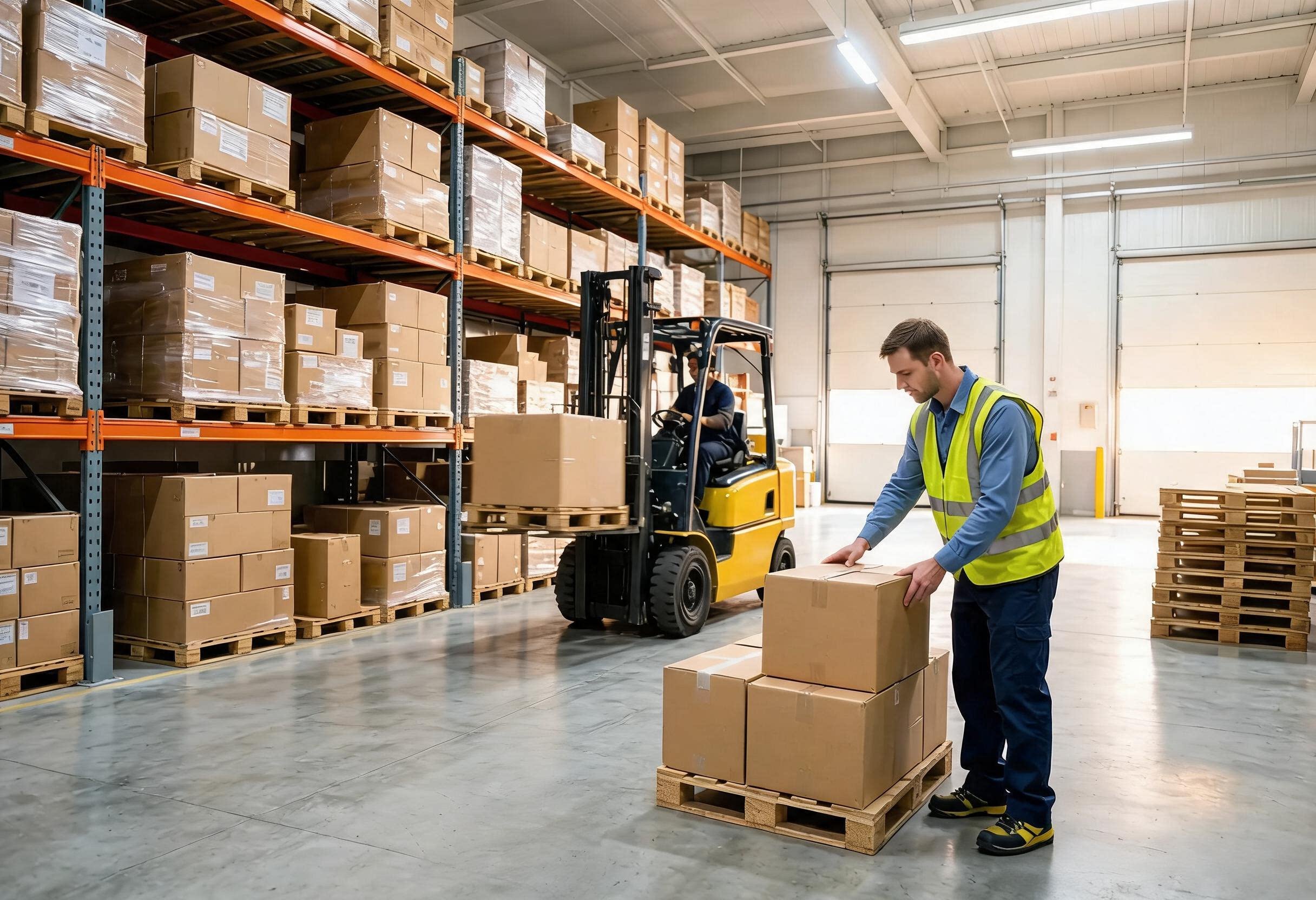
Most “scale your dropshipping store” tutorials quietly skip one awkward fact (Shopify’s dropshipping hub is typical): 3PL for dropshipping isn’t an upgrade you bolt on — it’s a different operating model. The moment you hold inventory in an overseas warehouse, you stop being a pure middleman and start running a small logistics company.
That shift scares sellers off, yet it quietly saves the ones who time it right. If you have pushed past 10–15 orders a day, watched refunds climb because parcels take three weeks, or shipped a bad batch with no quality check, you have already hit the ceiling.
You got into dropshipping for low capital and near-zero inventory risk — and that instinct is still right at the start. This guide shows what 3PL for dropshipping is, when it pays off, what it really costs per order, and how to migrate without stranding cash in dead stock. When it fits, we’ll point you to our 3PL fulfillment & overseas warehousing services.
If you are still at the “how do I begin?” stage, our how to start a dropshipping business guide maps the path from zero to first sale.
Key Takeaways
- 3PL for dropshipping means you own inventory in a warehouse near your buyers; pure dropshipping means the supplier ships and you own nothing.
- Direct shipping hits a hard ceiling around 7–25 day transit, freight volatility, no brand packaging, blind quality control, and platform penalty scores.
- All-in 3PL fulfillment typically lands at $8–$12 per order once receiving, storage, pick & pack, and shipping are amortized.
- The trigger is not a magic order count — it is steady volume on a narrow set of SKUs plus pain on speed, returns, or quality.
- Move only proven winners first; shipping your full untested catalog into a warehouse is the fastest way to pay storage on dead inventory.
What Is 3PL for Dropshipping?
3PL for dropshipping means buying proven products in bulk, shipping them to an overseas warehouse near your customers, and letting that provider store, pick, pack, and ship each order locally — so you own inventory and control speed, branding, and quality.
The broader dropshipping market is still expanding fast — Grand View Research puts it near $584 billion in 2026, growing about 20% a year (other analysts size it smaller). Sellers who outgrow the testing phase eventually hit the same walls.
3PL vs. Pure Dropshipping — The Core Difference
In pure dropshipping, the supplier holds stock, prints the label, and drops the parcel at your customer’s door. You never touch the product. That is liberating for testing — but you have no say over speed, box, or defect rate.
In a dropshipping 3PL setup, you buy inventory in bulk and freight it to a warehouse near your demand. The 3PL handles receiving, storage, pick & pack, and last-mile delivery. You own the goods until delivered — buying speed, branding, and inspection at the cost of working capital.
Neither is “better.” Direct shipping wins for validation; 3PL wins for scale.
Where Overseas Warehouses Fit In
Overseas warehousing for dropshipping is simply placing that 3PL node in your buyer’s region instead of your supplier’s. An overseas warehouse is a 3PL node in your customer’s region, not your supplier’s. For a US store sourcing from China, that means inventory in a US center; for the EU, one in Germany, Poland, or the Netherlands. Our dropshipping fulfillment services cover both models side by side.
The “overseas” part compresses the last mile. A parcel from a Shenzhen factory to Ohio takes 7–25 days; the same parcel staged in Ohio takes 2–5. The product did not change — the experience did.
Why Dropshipping Sellers Hit a Direct-Shipping Ceiling
Direct shipping is brilliant for $0 inventory risk and terrible for experience at volume. At scale, five limits pile up fast:
- 1. Transit time erodes trust. Three weeks reads as “scam?” and chargebacks climb with delivery days.
- 2. Freight cost volatility. Ocean and air rates swing with holidays and fuel; a winner’s margin can vanish before you ship.
- 3. Brand packaging is out of your hands. The box is the supplier’s — no thank-you card, discount code, or custom mailer.
- 4. Quality control is blind. A bad batch reaches customers before you learn it exists.
- 5. Platform penalty scores. Slow fulfillment drags your seller rating, visibility, and sales.
Research from Ipsos shows delivery reliability is now a top reason shoppers abandon carts or refuse to reorder — for repeat-purchase categories, speed is the product.
Story time — anonymized, but real
“Store A” did ~15 orders/day across kitchen gadgets from four Alibaba suppliers that never synced — one shipped in 5 days, another in 18. “Incomplete order” refunds passed 9% of revenue. After moving the top three SKUs to a US overseas warehouse, transit fell from three weeks to 6–8 days, refunds dropped ~40%, and tracking tickets nearly vanished. The catch: they moved proven winners, not the full 40-SKU catalog.
3PL vs. Direct Shipping — A Real Cost & Control Comparison
Cheaper per unit misses the point. What you actually keep — after speed, refunds, and returns — is the number that decides it. Here is the delivery-time gap, then the numbers.
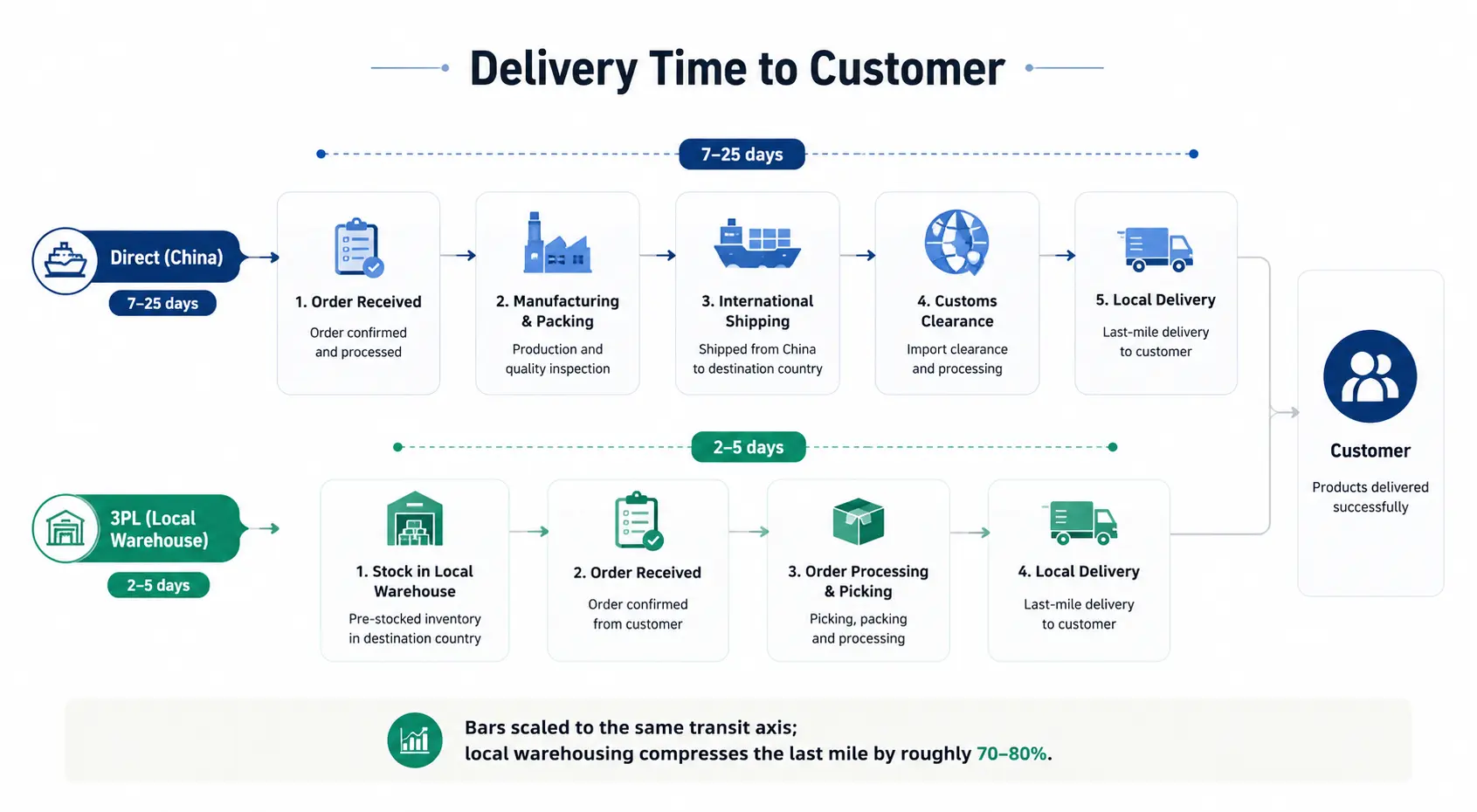
Shipping Speed
Direct shipping from Asia to the US or EU runs 7–25 days, longer in peak season. A parcel staged in a local overseas warehouse ships in 2–5 business days — the gap between a one-time buyer and a loyal one for repeat-purchase categories.
Per-Order Cost Breakdown
On the fulfillment line, direct shipping looks cheaper because the supplier eats pick & pack. But “cheaper per unit” hides freight and risk; a 3PL trades long-haul uncertainty for a predictable $2–$5 pick & pack plus local shipping.
Returns & Customer Experience
This is where direct shipping bleeds. A cross-border return means mailing a parcel back across an ocean while you eat inspection, restocking, and often a destroyed product. Benchmarks put a cross-border return at roughly $22.40 versus $6.10 for a local-warehouse return.
| Factor | Pure Dropshipping (direct) | 3PL for Dropshipping |
|---|---|---|
| Inventory ownership | Supplier’s | Yours |
| Transit time | 7–25 days | 2–5 days |
| Per-order fulfillment | Low unit cost, slow | $2–$5 pick & pack + local ship |
| Returns | Cross-border, ~$22.40/order | Local, ~$6.10/order |
| Brand control | Minimal | High (packaging, inserts) |
| Quality check | None / blind | Possible before storage |
| Upfront cash | Near zero | Inventory + freight |
The Real Cost Structure of 3PL
The fear “3PL is only for funded brands” comes from seeing rate cards out of context. Here is the actual anatomy of the bill.
Fee Breakdown
| Fee | Typical range | When charged |
|---|---|---|
| Receiving | $25–$50 / pallet | Inbound stock arrival |
| Storage | $15–$45 / pallet / month or $0.45–$0.75 / cu ft | Monthly |
| Pick & pack | $2–$5 / order | Per order |
| Returns handling | $3–$10 / order | Per return |
| Account / minimum fee | $0–$250 / month | Monthly (some waive it) |
Note what is not in the base fee: long-term storage, kitting, relabeling, and fuel surcharges — the charges that show up on your first invoice, never on the rate card.
Worked Example — All-In Per-Order Cost
Take a store doing 300 orders a month of one hero SKU. A sea shipment lands 500 units in a US warehouse.
- Receiving ($40 pallet ÷ 500 units) ≈ ~$0.20 with handling.
- Storage (quarter-pallet, 2-month sell-through) ≈ ~$0.30 buffered.
- Pick & pack ≈ $3.00; last-mile shipping ≈ $5–$8.
Add them and you land near $9.50/order, inside the $8–$12 band. At scale, receiving and storage amortize further.
Hidden Fees to Watch
- Minimum monthly fee — $0–$250/month at low volume, often waived above a threshold.
- Long-term storage — units sitting past 30–90 days get surcharged.
- Kitting / bundling — combining SKUs is a separate per-unit fee.
- Labeling / relabeling — mismatched barcodes cost you to fix.
- Fuel surcharges — carriers add these; they track oil, not your contract.
When you compare quotes, ask for the all-in landed cost at your volume, not the headline pick & pack rate.
When to Use 3PL for Dropshipping
Forget “am I big enough?” Ask the sharper question: is direct shipping now costing you more than holding inventory would? Here are the signals.
5 Signals It Is Time to Move
- Steady volume on a narrow set of SKUs — one or two products carry most orders.
- Speed complaints or speed-based refunds — “too slow” shows up in tickets and reviews.
- You want branded, custom packaging — inserts and unboxing moments pure dropshipping cannot deliver.
- CS is drowning in “where is my order?” — more time tracking parcels than growing the store.
- You need real quality control — a defective batch would hurt more than inspection costs.
The “20 Orders/Day” Myth vs. Reality
You will hear “switch at 20 orders a day.” That is a rule of thumb, not a law. What matters is SKU turnover: a store doing 12 orders/day on one hero SKU beats one doing 25 across 80 dead SKUs. Narrow, fast catalogs amortize storage; wide, slow ones fund a warehouse of dust.
When to Stay on Direct Shipping
Do not switch if you are still in any of these states:
- Testing products — no validated winner yet; inventory is pure risk.
- Low AOV under ~$15 — margin cannot absorb pick & pack plus freight.
- Sharply seasonal, no baseline — off-season stock is a liability, not a lever.
One cautionary tale, anonymized
“Store B” hit $10K/month and moved its entire 47-SKU catalog into a warehouse. No SKU sold more than 8 units/week. Within two months, storage on 40 stagnant SKUs outpaced fulfillment savings, and they sat on four-figure dead inventory. The lesson: do not fund a warehouse with unproven products.
How to Choose a 3PL / Overseas Warehouse
Picking a partner is less about the cheapest rate card and more about fit with your store. Run this checklist.
- Warehouse location vs. demand. If 70% of orders are US, a US warehouse beats a distant “global” node. Match the warehouse to the buyer.
- Platform integration. Native Shopify, WooCommerce, or Amazon connections save manual pushing. Confirm the WMS talks to your store first.
- Transparent pricing. Get the full fee table — receiving, storage, pick & pack, returns, minimums — in writing, surcharges named.
- Accuracy and support. Ask the pick accuracy rate and who answers at 2 a.m. A 99.9% claim means 1 in 1,000 errors; at volume that is real money.
- Value-added services. QC on arrival, custom packaging, kitting, and local returns are where a 3PL earns its keep; Packhelp argues the unboxing moment wins or loses brands.
- A real WMS. You need live inventory, order status, and reporting — without it you cannot plan reorders.
Two upstream choices decide whether a warehouse actually helps. Solid supplier sourcing sets the quality that arrives at the dock. A pre-shipment inspection step catches bad batches before they ever reach a customer. Debating branded mailers? Our custom packaging ROI breakdown shows whether the unboxing moment is worth it for your store.
Common Pitfalls
Most 3PL failures are self-inflicted at the decision, not the provider.
- Switching too early. Moving unproven products strands unsellable cash. Validate first.
- Switching too late. A quality crisis or penalty-score spiral costs the store, not just margin.
- Picking the cheapest quote. Low pick & pack hides storage minimums and weak support. Total landed cost is the only number.
- Ignoring returns. A 3PL without local returns pushes you back to cross-border pain.
- An unprofessional RFQ. Vague volume, SKUs, and zones get a vague quote. Bring real numbers: SKUs, units/week, dimensions, weight, destination mix.
Here’s what happened to a store we’ll call C
“Store C” ran on China-direct shipping with 15+ day delivery. In peak season, delays triggered a wave of “item not received” disputes on PayPal and Stripe; payouts froze for weeks while the supplier couldn’t confirm delivery. After moving to a local 3PL with tracked 3–5 day delivery and proof of delivery, dispute rates dropped and freeze risk largely disappeared. For high-volume stores, delivery proof is account protection.
Step-by-Step — Moving from Direct Shipping to 3PL
Treat the move as a controlled handoff, not a leap.
- 1. Validate the winner. Test on supplier-direct until one SKU shows steady, repeatable demand.
- 2. Forecast volume. Use 4–8 weeks of real sales, not hope, to size the first shipment.
- 3. Freight in bulk. Sea for cost, air for first replenishment; never air-freight the whole catalog.
- 4. Integrate systems. Connect your store to the 3PL’s WMS so orders route automatically.
- 5. Test a small batch. Run 50–100 units end to end before committing the full forecast.
- 6. Scale, keep a backup. Shift volume gradually and leave a supplier-direct safety net.
Frequently Asked Questions
Is 3PL the same as dropshipping?
No. Pure dropshipping means the supplier ships each order directly to the customer and you never touch inventory. With a 3PL, you buy stock in bulk, send it to a warehouse near your buyers, and the 3PL picks, packs, and ships each order locally. You own the inventory and the customer experience.
Does 3PL cost more than direct dropshipping?
On the fulfillment line, usually yes — but total landed cost often drops once you factor in faster shipping, fewer refunds, and cheaper returns.
Can beginners use a 3PL?
Not as a first move. A 3PL works best after you validate a product and see steady daily orders; beginners should stay on direct shipping to test demand.
How fast is 3PL shipping?
From a local overseas warehouse, 2–5 business days — a major improvement over the 7–25 days typical of China-direct routes.
What is the minimum order volume for a 3PL?
There is no hard floor, but most sellers benefit once a single SKU moves roughly 8+ units per week, or the store clears about 15–20 orders/day across a narrow catalog. SKU turnover matters more than raw order count.
How do I transition from direct shipping to a 3PL?
Validate the winner on direct shipping, forecast volume, ship a bulk container to the warehouse, integrate your store via the 3PL’s WMS, test a small batch, then scale. Keep direct shipping as a backup during the switch.
Conclusion
3PL for dropshipping isn’t a box to tick on a “scale your store” checklist. It’s the model you choose the moment direct shipping costs more than inventory would — and everything above points the same way: the $8–$12 band, returns falling from ~$22 to ~$6, transit shrinking from weeks to days.
Move only proven winners first. Validate, forecast, freight in bulk, integrate, test small, then scale — and keep a direct-shipping safety net. Done right, a warehouse turns your biggest weakness (delivery) into your strongest retention lever.
Ready to model the real numbers for your store?
Talk to our 3PL for dropshipping services team and get a per-order cost built from your actual catalog, shipping zones, and volume.
Guide index: related reading
- What is a 3PL for Dropshipping? The Ultimate Guide to Scaling in 2025
- Best 3PL for Dropshipping: A Comparison Framework That Survives Growth
- How to Find Dropshipping Suppliers: The 2026 Sourcing Guide for Growing Stores
- Custom Packaging for Dropshipping: A Practical Guide to Branded E-commerce Opera
- How to Vet a Dropshipping Agent: The Technical Verification Guide (2026)
- Dropshipping Quality Control: A Technical Guide to Reducing Defect Rates
- What Is 3PL Dropshipping? How It Actually Works in 2026
- 3PL Dropshipping: Strategic Fulfillment Solutions for E-commerce Scalability
- How to Switch to 3PL Dropshipping Without Breaking Your Business
- 3PL Dropshipping: The Secret to Scaling Beyond Direct Suppliers
Our services: dropshipping fulfillment (order-to-delivery workflow and per-order costs), sourcing & procurement (supplier vetting and negotiation), and 3PL fulfillment for overseas warehousing.