

You can learn how to start a dropshipping business in a single weekend. Thousands of people do exactly that every month. They pick a product, spin up a Shopify store, connect a supplier app, and run their first ad by Sunday night. Then month two arrives. The supplier misses two shipment windows. Customers start leaving one-star reviews about three-week delivery. Chargebacks climb. The store that felt like a launch now feels like damage control.
If that story sounds familiar, you’re not alone. You’re not bad at business, either. You’ve just been handed the highlight reel without the part where the supply chain breaks.
Here’s what we’ll do differently. Most “start a dropshipping business” guides stop at “pick a product and run ads.” This one walks the full path from your first sale to a brand that can survive tripling its orders. We’ll cover the 10 steps that actually matter, the supplier trap that sinks 84% of stores, the real margin math (not the “$100 and you’re rich” version), and exactly what breaks when you scale.
By the end you’ll have a 30-day checklist and a clear picture of whether you should run fulfillment yourself or hand it to a partner. Let’s get into it.

The 10 steps at a glance:
- Pick a niche that survives past month three
- Validate demand with real data
- Choose your platform (Shopify, WooCommerce, or TikTok Shop)
- Find reliable dropshipping suppliers
- Build a store that converts
- Brand it with custom packaging and private label
- Control quality and returns before they bite
- Set up fulfillment that scales
- Price for real profit
- Launch, market, then automate
Key Takeaways
- The global dropshipping market hit $290.7 billion in 2025 and is projected to reach $1.84 trillion by 2035 (Global Market Insights), so demand for the model is not slowing down.
- 84% of retailers name finding a reliable supplier as their #1 challenge (SaleHoo), and supplier reliability, not product choice, is what makes or breaks stores.
- Only about 10–20% of dropshipping stores stay profitable long-term, and realistic net margins land at 15–20% for experienced sellers.
- Successful stores invest $5,000–$10,000 in the first three months (not $100), with the money going to validation, branding, and ads, not inventory.
- At scale, the winners move to branded fulfillment partners for 24-hour processing, custom packaging, and 6–12 day global shipping so they can focus on growth instead of logistics.
What Is Dropshipping — and Is It Still Worth It in 2026?
Short answer: the model is healthier than ever, but the easy version is dead. Let’s break down what you’re actually getting into.
The 3-party model in 30 seconds
Dropshipping is a retail fulfillment method where you sell products without holding inventory. When a customer orders, your supplier packs and ships the item directly to them.
Three parties sit in the loop:
- You (the merchant) run the storefront, set prices, and own the customer relationship.
- The supplier holds inventory, packs the order, and ships it.
- The customer buys from you and receives the product directly from the supplier.
You never touch the inventory. When an order comes in, it’s forwarded to the supplier, who picks, packs, and ships. Platforms like Shopify describe this exact flow in their official dropshipping guide. It’s the reason the barrier to entry feels so low.
The trade-off is the catch. You trade inventory risk for control risk. You don’t own the warehouse, the packing quality, or the delivery speed. When any of those break, the customer blames you.
The market in numbers
This is not a shrinking fad. According to Global Market Insights, the global dropshipping market was valued at $290.7 billion in 2025 and is expected to grow at a 20.6% CAGR to roughly $1.84 trillion by 2035. Independent research from Grand View Research points the same direction, estimating a similarly large and fast-growing market. Roughly 27% of online retailers now use dropshipping as a primary fulfillment model (Dropshipping.com, via SaleHoo’s 2026 statistics roundup).
That 27% matters. It means the model is now mainstream infrastructure, not a fringe side hustle. For a growing Shopify or DTC seller, that’s good news: suppliers, apps, and logistics partners have matured enormously since 2020.
The honest catch
Now the part the gurus skip. The single biggest reason dropshipping stores fail isn’t the model. It’s the supplier. As SaleHoo’s 2026 data puts it, 84% of retailers name supplier reliability as their hardest problem. Late shipments, quality failures, and vanished inventory destroy brands faster than any ad campaign can build them.
And the profitability bar is real. Only about 10–20% of dropshipping stores stay profitable long-term, with net margins of 15–20% for experienced sellers (beginners often run below 10%). The model works, but only for operators who treat it like infrastructure, not a lottery ticket.
Mini-story #1 — The weekend launch that broke in month two.
“Jake” built a minimalist home-office store in a frantic Saturday. He connected a generic AliExpress supplier, ran $15/day in TikTok ads, and pulled 40 orders in his first three weeks. Then it collapsed. The supplier’s fulfillment time crept from 12 days to 28. Three customers opened “item not received” disputes. His review average dropped to 2.1 stars. By week nine, his ad account was flagged for a high refund rate and his cost per acquisition had tripled. Jake didn’t pick a bad product. He picked a supplier with zero accountability. The store survived only after he rebuilt the supply chain from scratch.
That story sets up everything else. Every step below is designed to keep you on the profitable side of those statistics.
Step 1 — Pick a Niche That Survives Past Month Three
The #1 beginner mistake is choosing a product because it’s trending, not because it has a defensible reason to exist in six months.
A niche that survives past month three usually has three traits:
- High perceived value, low return rate. Jewelry, accessories, wellness, and specialty home goods outperform fragile gadgets and cheap electronics, where returns and “not as described” complaints wreck margins.
- Brandable, not commoditized. If a customer can find the exact same item on Amazon in two clicks for less, you’re racing to the bottom. You want products where your packaging, story, and curation add value.
- Lightweight and durable to ship. Heavy or breakable items inflate shipping costs and damage rates, the silent killers we’ll cover in Step 7.
Don’t chase “the next fidget toy.” Chase a customer with a specific problem and a willingness to pay for a better version of the solution.
Step 2 — Validate Demand With Real Data
Guesswork is expensive. Validation is cheap. Before you spend a dollar on inventory decisions or ads, confirm people actually want this.
Three validation moves that take an afternoon:
- Trend and competitor spying. Tools like ZIK Analytics let you see which Shopify and eBay stores are already selling a product, at what price, and how fast. If five competitors are quietly doing real volume, demand is proven.
- Search-interest checks. Google Trends shows whether interest is rising, flat, or seasonal. A flat-but-stable curve beats a spiky one-week fad for a sustainable brand.
- Small paid test. Run $5–$10/day on one platform to a single product page. If you can’t get a click-through and add-to-cart signal at a reasonable cost, the product isn’t ready, and you’ve only lost a few dollars finding out.
Step 3 — Choose Your Platform (Shopify vs WooCommerce vs TikTok Shop)
Your platform is your storefront foundation, so pick based on your skills and where your customers already shop.
| Platform | Best for | Trade-off |
|---|---|---|
| Shopify | Beginners to scaling brands; huge app ecosystem | Monthly fee; less code control |
| WooCommerce | WordPress users who want full customization | You manage hosting, security, updates |
| TikTok Shop | Impulse, video-native product discovery | Algorithm-dependent; needs constant content (see TikTok Shop Seller University) |
Here’s the part most guides miss. You don’t have to choose one. Growing sellers increasingly run Shopify, WooCommerce, and TikTok Shop in parallel, syncing orders into a single backend (often a unified merchant dashboard). That’s exactly why an automated fulfillment pipeline matters. When orders hit from three channels at once, you need one fulfillment engine that absorbs them all without manual forwarding.
If you’re starting cold, Shopify is the default: lowest friction, best app support, and native dropshipping integrations. You can add TikTok Shop and WooCommerce later once you’ve proven demand.
Step 4 — Find Dropshipping Suppliers (the part 84% get wrong)
Finding reliable dropshipping suppliers is where stores are won or lost. Remember the stat: 84% of retailers say finding a reliable supplier is their hardest problem. That’s not a coincidence. It’s the industry’s structural weak point.
The AliExpress trap vs a vetted China fulfillment partner
The “AliExpress trap” is seductive. Huge catalog, no minimums, one-click import. But you’re sharing that catalog with a million other sellers, shipping windows stretch to 20+ days, and when something breaks, you’re a faceless ticket in a queue.
A vetted China fulfillment partner flips the model. Instead of you hunting individual product listings, a partner handles product sourcing China. It vets factories, negotiates price, holds stock in a bonded warehouse, and ships under your brand, so you get China’s cost edge without the chaos. Our product sourcing & procurement from China service is built exactly for this.
Not sure what that partner role actually looks like day to day? Our guide on what is a dropshipping agent breaks down how a sourcing agent sits between you and the factory floor.
Mini-story #2 — Marcus and the logistics rescue.
Marcus founded TrendSpire, a DTC fitness-accessory brand, and grew fast on TikTok. Too fast. His original supplier couldn’t keep up. Orders stacked up, tracking went silent for nine days at a time, and his Instagram DMs filled with “where’s my order?” messages. “I was one bad week from losing the brand I’d built,” he told us. The turning point was handing fulfillment to a managed partner who took over sourcing, QC, and shipping. Within a month, his processing time dropped from “whenever” to under 24 hours, and his refund rate fell by more than half. Marcus didn’t change his products or his ads. He just removed himself as the bottleneck.
Step 5 — Build a Store That Converts
Traffic is useless if your store leaks it. Two numbers should frame every design decision:
- Cart abandonment averages ~70.22% across ecommerce (Baymard Institute’s meta-analysis of 50 studies). Most of that is just browsing, but a big slice is fixable friction: surprise shipping costs, forced account creation, slow mobile checkout.
- Mobile commerce drives roughly 45% of US ecommerce, yet mobile carts abandon even harder than desktop. If your store isn’t flawless on a phone, you’re bleeding the majority of your traffic.
Conversion checklist:
- One-product or tight-collection pages with a clear hero shot and a single call to action.
- Transparent shipping times stated before checkout. Hiding them is the #1 fixable abandonment cause.
- Guest checkout enabled; never force account creation.
- Fast load times (under 3 seconds); 40% of users leave a site that’s slower.
- Social proof — reviews, UGC, and a visible refund policy build the trust a faceless model lacks.
Step 6 — Brand It or Be Forgotten: Custom Packaging & Private Label
In a sea of identical products, your packaging is the only thing the customer physically touches. Generic bubble-mailer-and-invoice fulfillment trains customers to remember the product, not you, and to re-order from whoever’s cheapest next time.
Custom packaging for dropshipping turns a transaction into a brand moment. A branded box, a thank-you insert, a private-label product: these lift repeat purchase rates and give customers a reason to post about you on social. Our breakdown shows how small changes (a logo sticker, a reusable pouch) move the needle on lifetime value.
Branding isn’t vanity at scale. It’s the moat. When Anna’s team scaled (more on her in a moment), custom packaging was the single biggest lever on repeat orders.
Step 7 — Quality Control & Returns: The Silent Profit Killers
Returns feel like a customer-service problem. They’re actually a margin problem. A 10% return rate on a 20% net margin means you’re shipping five orders just to break even on the returned one’s logistics. Catching defects early is the fix, and our pre-shipment quality inspection process is built for exactly that.
The fix is upstream, not downstream:
- Pre-shipment inspection. Catch defects before they reach the customer. A pre-shipment QC step at the warehouse catches broken clips, wrong colors, and missing parts while the product is still in China, far cheaper than a refund plus a bad review.
- Clear sizing and specs. Most “not as described” returns come from expectation gaps, not product faults.
- A generous-but-smart return policy. Build trust upfront; use inspection to keep the actual return volume low.
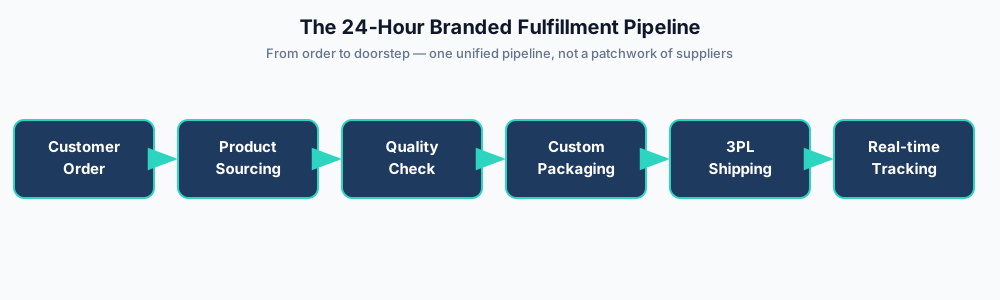
Step 8 — Set Up Fulfillment That Scales (3PL, 24-hr Processing, 6–12 Day Global Shipping)
Fulfillment is where a hobby store becomes a business. The goal: orders flow from “placed” to “shipped” without you touching them.
What scalable fulfillment looks like in 2026:
- 24-hour order processing — orders are picked and packed within a day of purchase, not whenever the supplier gets to it.
- 3PL warehousing & global shipping — inventory sits in a bonded warehouse near your customers, cutting delivery from weeks to days.
- 6–12 day global delivery for cross-border orders, with real-time order tracking so customers never wonder where their package is.
- One dashboard — the Dropioneer merchant dashboard unifies Shopify, WooCommerce, and TikTok Shop orders into a single view.
This is the 24-hour fulfillment model. You sell, the system ships, and you watch it happen from one screen instead of herding supplier spreadsheets.
See how 24-hour branded fulfillment actually works
From order sync to branded box at the customer’s door.
Step 9 — Price for Profit (the margin math nobody shows you)
The “$100 to start” myth is the most expensive lie in dropshipping. Here’s the real unit economics on a $45 accessory:
| Line item | Amount |
|---|---|
| Retail price | $45.00 |
| Product / COGS | −$12.00 |
| Shipping | −$4.00 |
| Payment processing (2.9% + $0.30) | −$1.61 |
| Platform & app fees (amortized) | −$1.00 |
| Refund / chargeback reserve | −$2.00 |
| Gross profit before ads | $24.39 |
| Ad cost per order (realistic) | −$10–$15 |
| Net margin | ~15–20% |
Notice what’s missing from the “$100 business” pitch: the ad spend. Customer acquisition is your largest variable cost, and it’s where most stores quietly lose money. The stores that thrive treat $5,000–$10,000 in the first three months as the realistic budget, spread across validation, branding, and paid traffic, not as a scary number to avoid.
Price for the margin you need after ads and returns, not before. If the math doesn’t work at a 20% net margin, the product isn’t viable yet.
Step 10 — Launch, Market, Then Automate
Launch is not the finish line. It’s the start of the test-and-learn loop.
- Launch narrow. One hero product or a tight collection. Don’t open a 200-SKU supermarket on day one.
- Market where your customer lives. TikTok and Instagram for discovery-led products; Google Shopping for search-intent buyers; email capture from day one.
- Automate the repetitive. Order forwarding, tracking updates, and inventory sync should run on APIs, not manual copy-paste. That’s the whole point of an automated fulfillment setup.
- Watch the unit economics, not the revenue. $20K in sales at a 5% net margin is a worse business than $5K at 20%.
The Growth-Stage Reality Check — What Breaks When Orders Triple
You survived launch. Orders are climbing. Then they triple in a month, and suddenly the business that felt smooth starts cracking. Three things break first:
Supply-chain fragility
Your supplier that was “fine” at 20 orders a day buckles at 200. Lead times slip, stockouts hit, and your hard-won reviews turn sour. Fragility you never noticed at low volume becomes the thing that ends the brand.
Branding dilution
Scaling generic fulfillment means every new customer gets the same anonymous package your competitors send. Without custom packaging and consistent QC, growth actually weakens your brand identity.
You as the fulfillment bottleneck
At some point, you become the constraint. Manually forwarding orders, chasing tracking numbers, and answering “where’s my stuff?” DMs eats the hours you should spend on growth. This is the exact trap Marcus hit in Step 4, which is why real-time order tracking matters once volume climbs.
Mini-story #3 — Anna, LuxeWear, and the scaling unlock.
Anna runs a Shopify Plus store for LuxeWear, a premium loungewear label. Early on, she hand-managed a patchwork of suppliers and did her own QC. It worked until a viral TikTok sent orders up 3x in ten days. “We were shipping late, and our unboxing was inconsistent,” she recalls. “For a premium brand, that’s deadly.” The fix was moving to a partner that handled China sourcing & procurement, pre-shipment QC, and branded packaging under one roof. With logistics off her plate, Anna focused on collection drops and community, and LuxeWear’s repeat-purchase rate climbed noticeably. “Expanding our catalog stopped being scary,” she said.
This is the pattern: the stores that scale past the growth wall stop doing fulfillment and start directing it.
Why Growing Sellers Move to a Branded Fulfillment Partner
Once you’ve proven demand, your highest-use move isn’t another ad campaign. It’s stepping out of the logistics seat.
A branded dropshipping fulfillment from China partner like Dropioneer rolls sourcing, QC, packaging, and shipping into one working relationship:
- China sourcing & procurement — vetted factories, negotiated pricing, no minimum-order roulette.
- Pre-shipment QC — defects caught before they become 1-star reviews.
- Custom packaging & private label — every box builds the brand.
- 24-hour processing + 3PL warehousing — 6–12 day global delivery from stock positioned near your customers.
- Real-time tracking & one dashboard — you see everything; your customers see progress, not silence.
- Dedicated account manager — a human who knows your catalog, not a support ticket queue.
Handing off fulfillment is simply the structural fix for that 84% supplier problem we started with, not a sales pitch.
Frequently Asked Questions
How much does it cost to start a dropshipping business in 2026?
Realistic first-quarter budgets run $5,000–$10,000 spread across validation, branding, and paid traffic, not the $100 often quoted. The money goes to testing and building, not inventory.
What is the biggest reason dropshipping stores fail?
Supplier reliability. 84% of retailers name finding a reliable supplier as their #1 challenge, and late shipments or quality failures destroy brands faster than any ad campaign builds them.
Is dropshipping still worth it in 2026?
Yes. The model is healthier than ever (the market is projected to hit $1.84T by 2035), but the easy, low-quality version is dead. The winners validate demand, brand the experience, control quality, and build fulfillment that scales.
When should I move to a branded fulfillment partner?
Once demand is proven. A branded China fulfillment partner handles sourcing, QC, custom packaging, and 24-hour processing so you can focus on growth instead of logistics.
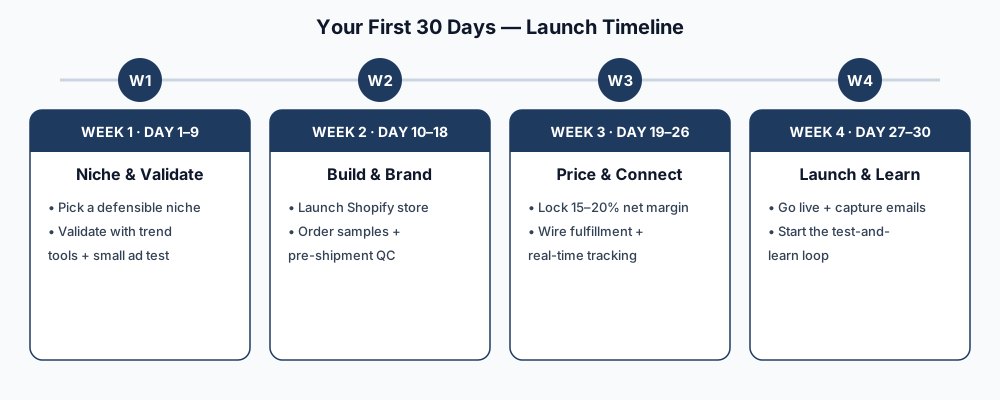
Your First 30 Days Checklist
| Day | Action | Done? |
|---|---|---|
| 1–3 | Pick a niche with high perceived value + low return rate | ☐ |
| 4–6 | Validate demand with trend tools + a small ad test | ☐ |
| 7–9 | Set up Shopify store; enable guest + mobile checkout | ☐ |
| 10–12 | Shortlist & vet 2–3 suppliers (samples ordered) | ☐ |
| 13–15 | Build branded storefront; write clear shipping policy | ☐ |
| 16–18 | Order samples; run pre-shipment QC review | ☐ |
| 19–22 | Finalize pricing for 15–20% net margin after ads | ☐ |
| 23–26 | Connect fulfillment + tracking automation | ☐ |
| 27–30 | Launch, capture emails, start the test-and-learn loop | ☐ |
Print it. Tick it. The stores that win are the ones that treat these 30 days as a plan, not a vibe.
Conclusion
Learning how to start a dropshipping business in 2026 is easier than ever to launch and harder than ever to win. The winners aren’t the cheapest supplier’s clients anymore. They’re the ones who validated demand, branded the experience, controlled quality, and built fulfillment that scales without them in the loop.
Do those five things right, and you put yourself on the profitable side of that 10–20% line. You don’t need to build all of it on day one. You need to start with the plan above, and know exactly when to hand the back office to people who do it for a living.
Start your free trial — no inventory, no hassle.
Talk to our team about vetted China sourcing, branded packaging, and 24-hour fulfillment built for growing DTC brands.