


Every carrier measures boxes the same way a customs officer reads a passport: by the numbers printed on the outside. Get those numbers wrong and your quote, your dimensional weight, and sometimes the entire shipment are wrong with them. This guide walks through how to measure box sizes for shipping the way carriers do, why the inside and outside dimensions of the same box are never the same, and how dimensional weight quietly decides what you actually pay.
Outside Dimensions: What Carriers Measure
Carriers measure the outside dimensions of a closed box at its widest points, including any bulge, tape layers, or edge protectors. The measurement is recorded as length × width × height, where length is always the longest side. Measure with the box flaps closed and sitting flat on a level surface — measuring an open or half-collapsed box is the most common source of quote disputes.
Round up, never down. Most carriers round each dimension to the next whole unit (inch or centimetre), and a box that measures 15.2 inches is billed as 16. Over a few hundred shipments, those rounding rules matter more than the tape measure itself.
Internal Dimensions: What Your Product Needs
The internal dimensions are what determine whether your product fits. Corrugated board thickness eats into the space: a box made from 5 mm board loses roughly 10 mm on each internal dimension compared to its outer size. When you order custom boxes, suppliers quote internal dimensions — when you buy stock boxes from a retail shelf, the printed size is usually external.
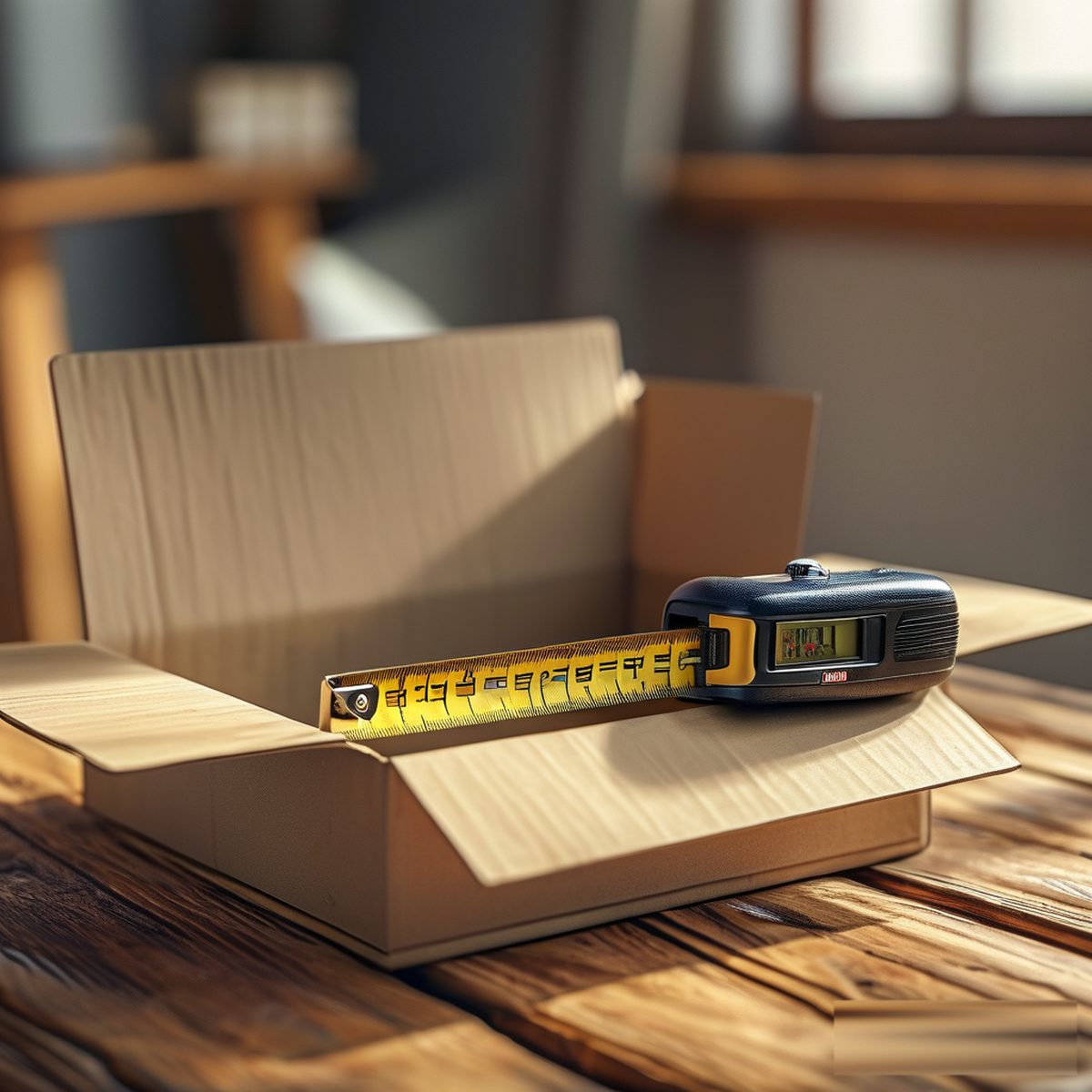
For fragile products, add the cushioning thickness on every face before choosing the box: a 20 cm product with 3 cm of foam on each side needs an internal length of at least 26 cm. Skipping this step is why so many “perfect fit” boxes arrive with crushed corners — the product was sized to the outer dimension of a smaller box.
Dimensional Weight: The Number That Bills You
Carriers charge on whichever is greater: actual weight or dimensional (volumetric) weight. The formula divides the box volume in cubic units by a carrier divisor — commonly 139 for US domestic in cubic inches, or 5000 for metric in cubic centimetres. A lightweight but bulky box can bill as if it weighed twice what the scale says.
| Box (L×W×H) | Actual weight | Dim weight (÷139, in³) | Billed weight |
|---|---|---|---|
| 16 × 12 × 10 in | 3 lb | 13.8 lb | 14 lb |
| 12 × 12 × 12 in | 5 lb | 12.4 lb | 13 lb |
| 24 × 18 × 18 in | 9 lb | 55.9 lb | 56 lb |
The third row is the lesson: a 9-pound shipment bills as 56 pounds because air is travelling in the truck. Right-sizing the carton is usually worth more than negotiating the rate card, which is why custom packaging cost and quality decisions should always start from measured, not assumed, box sizes.
A Measuring Sequence That Matches Carrier Re-Weighs
Carriers audit shipments with automated dimensioners that scan each parcel on a conveyor. If your declared dimensions differ from the scan, you get billed the difference plus an adjustment fee. A sequence that survives audits:
- Close all flaps fully and tape the seam flat.
- Measure length (longest side), then width, then height, at the widest point of each face.
- Round each dimension up to the next whole unit.
- Compute dim weight with the divisor your carrier publishes for your service level.
- Record the measurements on the packing slip — auditors look for consistency, not perfection.
| Mistake | What happens | Fix |
|---|---|---|
| Measuring internal dims for the quote | Carrier re-measure adds 1–3 cm per side plus fees | Always quote external dims |
| Measuring an unsealed box | Bulge inflates one face by 1–2 cm | Tape first, measure after |
| Rounding down | Every rounding error compounds into the dim weight | Round each dimension up |
| Ignoring pallet overhang | Freight audits bill the full pallet footprint | Measure load, not box stack |
Common Measuring Mistakes in Bulk Operations
High-volume shippers make one additional mistake: trusting the box supplier’s stated size without sampling. Corrugated tolerances run ±3 mm on each dimension, and a batch at the top of tolerance can push a whole SKU into the next dim weight break. Sample five boxes from every new batch, measure them sealed, and update your rate calculator with the measured average.
Frequently Asked Questions
Do I measure the box with the flaps open or closed?
Closed. Carriers measure sealed boxes, and any bulge from contents counts toward the dimension. Measuring open flaps understates the size and triggers adjustment fees.
Which dimension is the length?
The longest side of the sealed box. Length × width × height is the standard order, and the longest side is always listed first.
What divisor should I use for dimensional weight?
Use the divisor your carrier publishes for your contract: 139 (cubic inches) is common for US domestic retail rates, 5000 (cubic centimetres) for metric international rates. Freight contracts often use different divisors, so check the rate sheet.
Why does a light package cost so much?
Because dimensional weight, not the scale reading, sets the bill for bulky boxes. Reducing any single dimension by even 2 cm can drop the billed weight class — carton right-sizing is the fastest saving in most shipping budgets.