

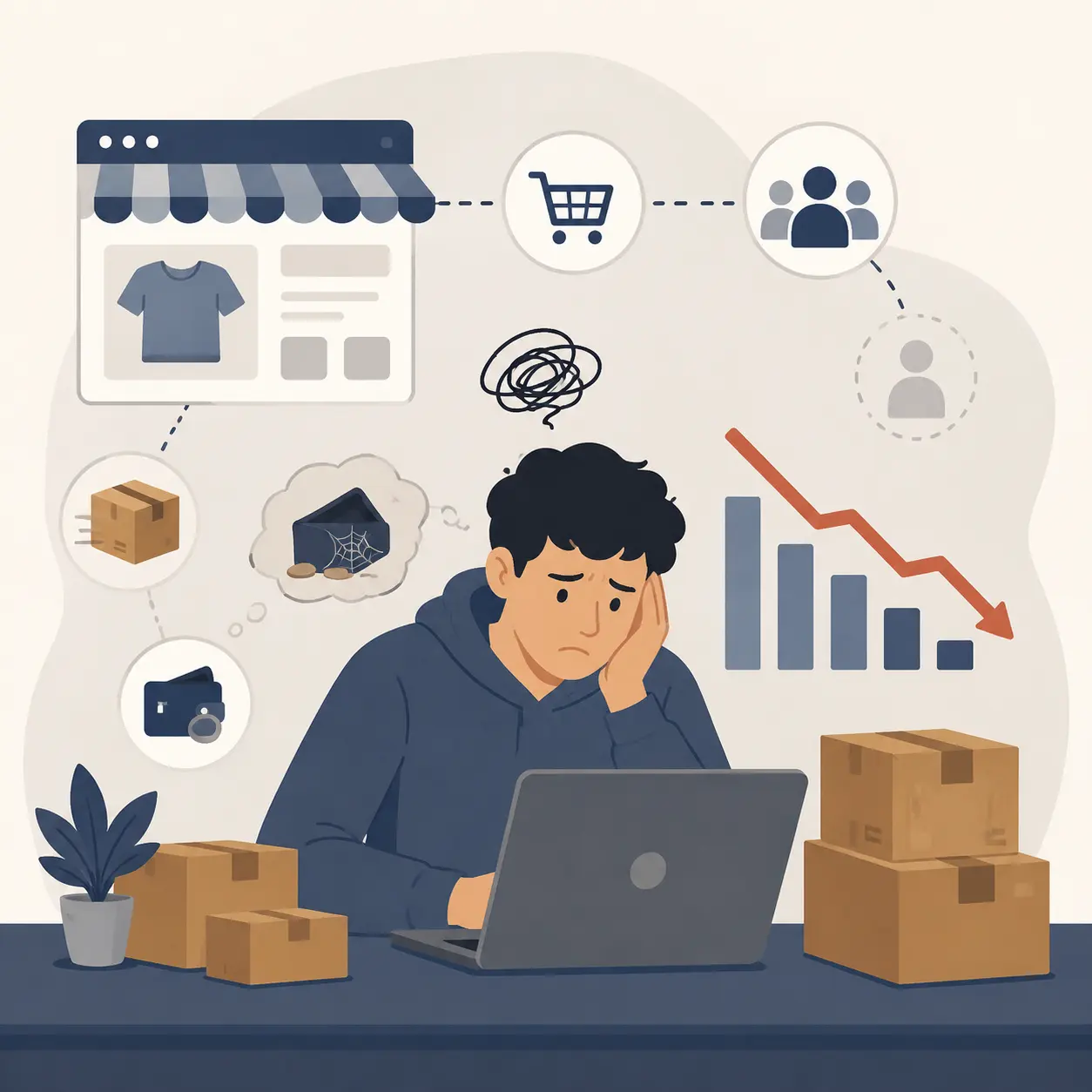
TL;DR – Quick Answer
If your dropshipping not profitable issue is draining your budget, it usually comes down to four critical failures:
(1) High customer acquisition costs (CAC) eating margins,
(2) Poor product quality leading to refunds,
(3) Slow shipping times destroying repeat purchases,
(4) Selling generic products with no brand identity.
To become profitable in 2026, you must transition from generic AliExpress sourcing to private labeling using a reliable 3PL for faster shipping, strictly controlling product quality, and optimizing your storefront for conversion.
The “High Revenue, Zero Profit” Illusion
You have set up your Shopify (e-commerce platform) store, imported winning products, and launched your Meta and TikTok ad campaigns. You check your dashboard and see thousands of dollars in revenue. Yet, when you calculate your Return on Ad Spend (ROAS), product costs, and merchant fees at the end of the month, your bank account is empty. You are left asking: “Why is my dropshipping store not making money?”
You are not alone. A situation where dropshipping is not profitable despite high sales volume is the most common hurdle e-commerce entrepreneurs face today. In the early days, you could easily source a $5 product, sell it for $20, and pocket a $10 profit after a $5 ad spend. Fast forward to May 2026, and the landscape has drastically changed. Ad costs have surged, consumer expectations are higher than ever, and generic stores are being heavily penalized by the market.
In this comprehensive guide, based on our decade of e-commerce supply chain experience at Dropioneer, we will break down exactly why do most dropshipping stores fail, whether the business model is still viable, and step-by-step strategies on how to make a dropshipping store profitable again.
Is Dropshipping Still Profitable in 2026?
Before we fix your store, let’s address the elephant in the room: Is dropshipping still profitable in 2026?
The Short Answer: Yes, absolutely. However, the traditional model of dropshipping (arbitrage with 30-day shipping from unvetted suppliers) is dead. The new model of dropshipping (building a micro-brand with private labeling and fast fulfillment) is thriving.
According to 2026 data from Statista, the global dropshipping market is projected to reach over $350 billion this year. The money is there, but it is flowing to brands that prioritize E-E-A-T (Experience, Expertise, Authoritativeness, and Trustworthiness) in the eyes of consumers. If you find your dropshipping not profitable, it is likely because your operational model is stuck in 2019.
Key Market Shifts in 2026:
- Rising CPMs: Meta and TikTok advertising costs have increased. You can no longer rely on a 1.5x ROAS to stay profitable.
- The “Amazon Prime” Expectation: Consumers expect delivery within 3 to 7 days. If you offer 15-20 day shipping, your conversion rates will plummet, and chargebacks will soar.
- Platform Crackdowns: Payment gateways (Stripe, PayPal) will ban your account quickly if your tracking numbers are slow to update or if your dispute rate exceeds 1%.
5 Reasons Why Do Most Dropshipping Stores Fail
If you are struggling with a dropshipping not profitable scenario, audit your business against these five common failure points.
1. Dropshipping No Sales After Ads (The Conversion Trap)
One of the most frustrating experiences is getting traffic but seeing absolutely zero return. You experience dropshipping no sales after ads, and your budget bleeds out. Why does this happen?
- Disconnect between Ad and Landing Page: Your TikTok ad promises a life-changing gadget, but your landing page looks like a generic template with spelling errors and fake countdown timers. Modern consumers spot scammy stores instantly.
- Slow Page Load Speed: If your Shopify store takes more than 3 seconds to load on mobile, 53% of users will bounce (Google 2026 Core Web Vitals Report).
- Pricing Strategy: If your product costs $10, and your Cost Per Acquisition (CPA) is $25, selling the product for $29.99 leaves your dropshipping not profitable. You mathematically cannot scale.
2. Sky-High Refund Rates Due to Poor Quality
Sourcing blindly from platforms like AliExpress means you have zero control over what your customer actually receives. You might advertise a premium stainless steel water bottle, but your supplier ships a cheap plastic knock-off.
This leads to angry emails, bad reviews, and costly chargebacks. To fix this, you must stop relying on random vendors. By working with a professional sourcing partner, you can implement a rigorous quality check process before the item ever leaves the warehouse. When your refund rate drops from 10% to 1%, your profit margins instantly expand.
3. Long Shipping Times Killing Customer Retention
In 2026, the most expensive mistake you can make is ignoring Customer Lifetime Value (LTV). If you spend $30 to acquire a customer, you might break even on the first sale. The real profit comes when they return to buy a second or third time.
But will a customer return if they had to wait 25 days for their first package? No.
While basic automated platforms like Zendrop offer decent improvements over standard ePacket, to truly compete with domestic brands, you need to leverage advanced logistics. By partnering with a dedicated 3PL (Third-Party Logistics) provider like Dropioneer, you can pre-stock winning inventory in local warehouses, achieving 3-5 day delivery times that guarantee customer satisfaction.
4. Selling Unbranded Commodity Products
If a customer can screenshot your product, upload it to the Amazon app using image search, and find it for half the price with next-day delivery, your dropshipping store will fail.
To avoid competing purely on price (which makes dropshipping not profitable), you must build perceived value. This is achieved through brand design. A custom logo, cohesive color palettes, and professional typography elevate a $5 commodity into a $40 branded experience.
5. Ignoring the Unboxing Experience
Shipping a product in a crushed, generic yellow bubble mailer screams “cheap overseas import.” When customers receive ugly packaging, their perceived value of the product drops, increasing buyer’s remorse and return requests.
Investing in product customization—such as custom branded packaging, thank-you cards, and custom inserts—creates a premium unboxing experience. This leads to user-generated content (UGC) on social media, giving you free organic marketing.
How to Make a Dropshipping Store Profitable: The 2026 Blueprint
Now that we know why stores fail, let’s look at the exact steps on how to make a dropshipping store profitable. We have condensed this into an actionable, step-by-step tutorial.
Step 1: Fix Your Unit Economics (The 3X Rule)
If your dropshipping not profitable issue persists, your pricing is likely wrong. Use the “3X Rule” for pricing in 2026:
- 1/3 for Product & Shipping: (e.g., $15)
- 1/3 for Marketing & Ads: (e.g., $15)
- 1/3 for Profit Margin: (e.g., $15)
This means if a product costs you $15 landed (product + shipping), your retail price must be at least $45. If the market won’t accept a $45 price tag for that item, do not sell it. Find a product with higher perceived value.
Step 2: Upgrade Your Supplier to a True 3PL
Stop using suppliers who only act as middlemen. You need a partner that handles the entire supply chain. Here is a comparison of why upgrading your fulfillment model is critical for profits:
| Feature | Old Dropshipping (AliExpress) | Automated Apps (e.g., Zendrop) | Premium 3PL Partner (Dropioneer) |
|---|---|---|---|
| Shipping Time | 15-30 Days | 7-15 Days | 3-7 Days (Global & Local) |
| Quality Control | None | Basic | Strict 1-on-1 QC Inspection |
| Custom Branding | Not Possible | Limited | Full Product & Packaging Customization |
| Profit Potential | Low (High Refunds) | Medium | High (Brand Loyalty & LTV) |
Step 3: Implement Post-Purchase Upsells
To combat high ad costs, you must increase your Average Order Value (AOV). If a customer buys a posture corrector, immediately offer them a massage roller at a 30% discount on the thank-you page. One-click upsells can increase your revenue by 10-15% without spending an extra dime on ads, directly impacting your bottom line.
Step 4: Shift from Conversion Ads to Retention Marketing
Stop relying 100% on Meta and TikTok ads. Start capturing emails and SMS numbers. Email marketing software (like Klaviyo) should account for 20-30% of your total revenue. Sending a weekly newsletter or an abandoned cart sequence is virtually free and highly profitable.
Frequently Asked Questions (FAQ)
Q: Is dropshipping still profitable in 2026?
A: Yes. However, it requires a brand-first approach. Store owners who utilize fast shipping (via 3PLs), private label their products, and focus on customer retention are seeing profit margins of 15% to 25%. The get-rich-quick, low-effort dropshipping model is no longer profitable.
Q: Why am I getting traffic but no sales after ads?
A: “Dropshipping no sales after ads” usually stems from a lack of trust on your website, a slow-loading landing page, or a mismatch between the ad’s promise and the actual product page. Ensure your pricing is competitive, reviews are realistic, and shipping policies are clearly stated.
Q: Why do most dropshipping stores fail in their first month?
A: Most fail because they exhaust their capital on poorly optimized ads without testing properly. Furthermore, relying on slow suppliers leads to payment gateway bans and refund requests, completely wiping out any initial profits.
Q: How can I improve product quality without holding inventory?
A: You can partner with a professional fulfillment agency like Dropioneer. We act as your boots-on-the-ground in manufacturing hubs, conducting thorough quality checks on every batch before it is shipped directly to your customer, ensuring high standards without you needing to buy bulk upfront.
Conclusion: Stop Losing Money, Start Building a Brand
If you are constantly asking, “Why is my dropshipping store not making money?”, it is time to pivot. High customer acquisition costs and demanding consumer expectations have made traditional dropshipping not profitable. To win in 2026, you must elevate your store from a simple drop-shipper to a legitimate e-commerce brand.
This means taking control of your supply chain, ensuring strict quality control, customizing your packaging, and drastically reducing your shipping times. You do not have to do this alone.
Ready to Make Your Dropshipping Store Profitable?
At Dropioneer, we are more than just a supplier; we are your complete supply chain partner. From product sourcing and quality checks to custom branding and lightning-fast 3PL fulfillment, we help e-commerce brands scale profitably.