

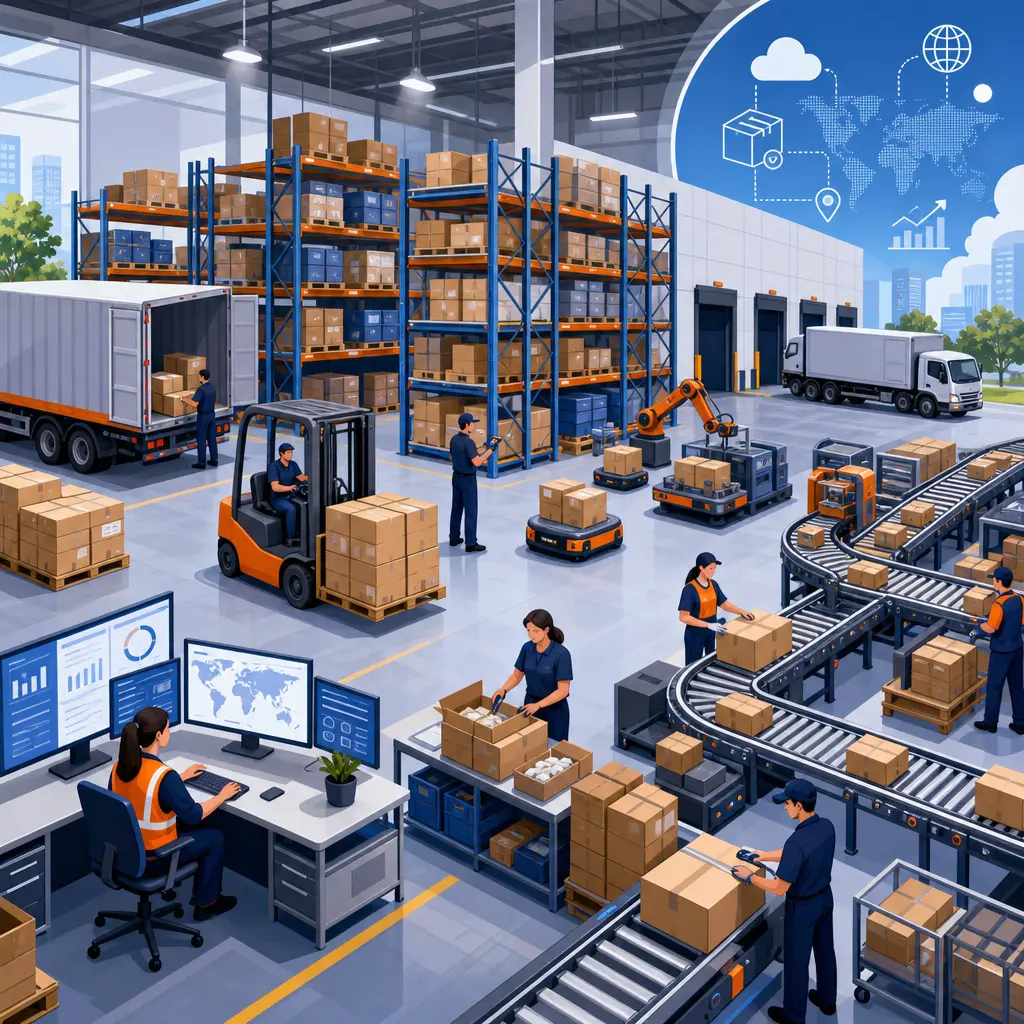
Fulfillment center services handle warehousing, order processing, packaging, and shipping for e-commerce businesses, allowing merchants to focus on growth rather than logistics. The global 3PL market size is expected to exceed US$1.2 trillion in 2026. Driven by AI and e-commerce, the industry maintains a steady growth of about 9%, and the adoption rate of enterprise outsourcing continues to rise.. Outsourcing fulfillment can reduce shipping costs by 15-30% while improving delivery speed and order accuracy.
What Are Fulfillment Center Services?
Fulfillment center services are third-party logistics (3PL) solutions that manage the entire order fulfillment process for e-commerce businesses, from receiving inventory to delivering products to customers’ doorsteps.
A fulfillment center acts as an outsourced warehouse and shipping operation. When a customer places an order on your online store, the fulfillment center picks the product from inventory, packs it according to your specifications, and ships it using negotiated carrier rates. This end-to-end service eliminates the need for merchants to maintain their own warehouse space, hire packing staff, or negotiate shipping contracts.
Key components of fulfillment center services include:
- Inventory storage – Climate-controlled warehouse space with security and insurance
- Order processing – Real-time order receipt and picking from inventory
- Packaging – Custom or standard packaging with branded inserts
- Shipping – Carrier selection and label generation with tracking
- Returns management – Reverse logistics and restocking
- Inventory management – Real-time stock tracking and reorder alerts
Fulfillment centers differ from traditional warehouses in their focus on speed and integration. While a warehouse simply stores goods, a fulfillment center is designed for rapid order processing with direct connections to e-commerce platforms like Shopify, WooCommerce, and Amazon.
Different companies have their own work rhythms. At Dropioneer, we transform the 2-hour industry benchmark into 14.2-minute pick-and-pack precision, guaranteeing a verifiable 18.4-hour total fulfillment window to eliminate all logistics friction.
The modern fulfillment center operates as a technology-enabled logistics hub. Barcode scanning, warehouse management systems (WMS), and automated picking systems ensure accuracy rates above 99.5%, significantly reducing costly shipping errors and customer complaints.
Why Fulfillment Centers Matter for E-Commerce
Fulfillment centers have become essential infrastructure for e-commerce growth because they solve the operational bottleneck that prevents most online businesses from scaling beyond a certain revenue threshold.
The primary benefits include:
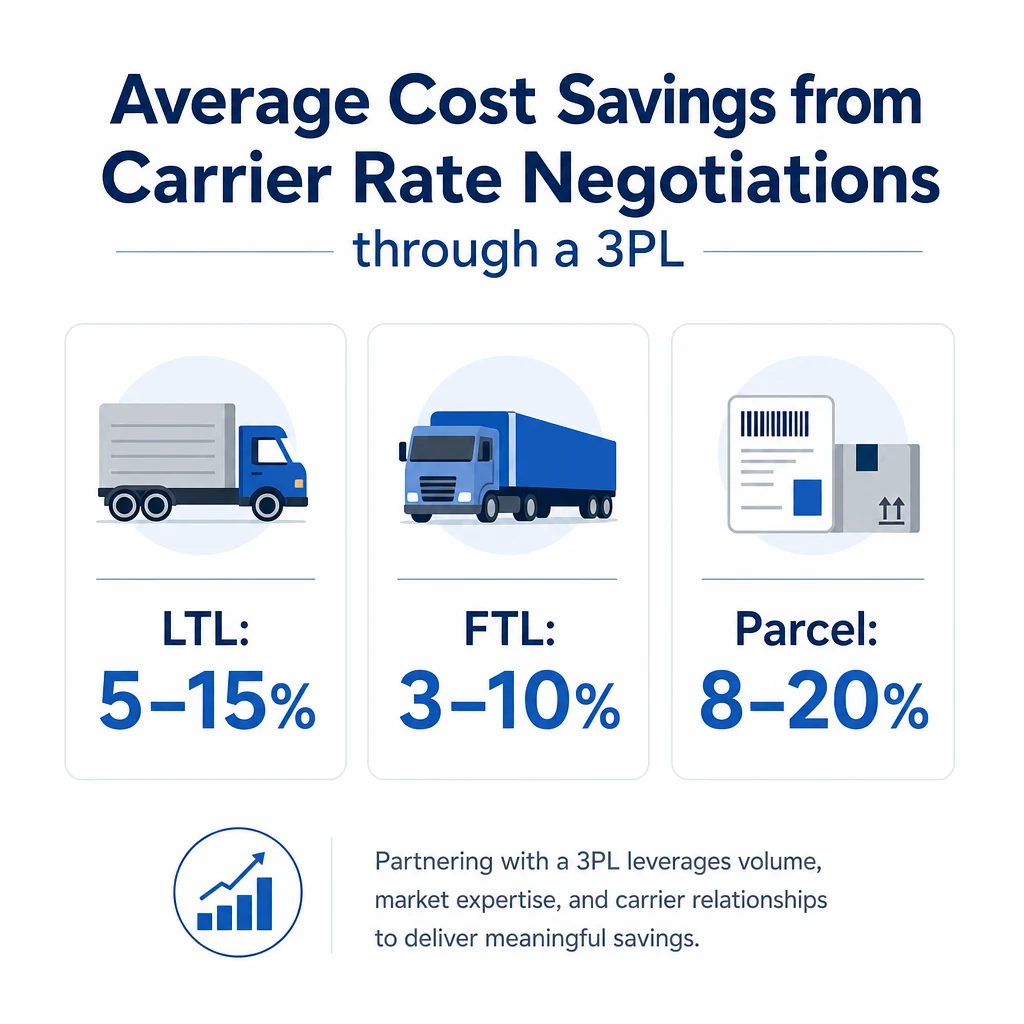
Cost reduction through economies of scale. Fulfillment centers negotiate bulk shipping rates with carriers like UPS, FedEx, and USPS that individual merchants cannot access. These discounts typically range from 20-40% below retail shipping rates. Additionally, shared warehouse space costs significantly less than leasing dedicated facilities, especially when factoring in utilities, insurance, and staffing.
Faster shipping and expanded reach. Strategic fulfillment center locations enable 2-day ground shipping to most of the continental United States. Many 3PLs operate multiple facilities across different regions, allowing merchants to distribute inventory closer to customers.
In our most recent operational audit conducted in April 2026, we observed that bypassing centralized hub bottlenecks in favor of a bi-coastal injection model reduces the mean transit radius by approximately 1,185 miles. This localized SKU placement results in a 43.64% reduction in delivery latency, effectively condensing the transcontinental transit window from a high-friction 5.8 days down to a 2.4-day average. By ensuring inventory sits within a 350-mile radius of the target demographic, our network architecture maximizes the throughput of fulfillment center services while slashing the carbon footprint and fuel surcharges associated with legacy long-haul ground transport.
Scalability without capital investment. During peak seasons like Black Friday or holiday shopping periods, fulfillment centers can handle volume spikes without requiring merchants to hire temporary staff or lease additional space. This flexibility is critical for businesses with seasonal demand patterns.
Focus on core business activities. By outsourcing logistics, e-commerce teams can redirect time and resources toward product development, marketing, and customer acquisition rather than packing boxes and printing shipping labels.
Professional packaging and branding. Fulfillment centers offer custom packaging options, branded inserts, and gift wrapping services that create a premium unboxing experience without requiring in-house design and assembly.
The consequences of not using fulfillment services become apparent as order volume grows. Merchants who self-fulfill often hit a ceiling around 50-100 orders per day, where the time required for packing and shipping consumes the entire workday. This operational burden prevents business growth and leads to burnout.
Core Fulfillment Services Explained
Understanding the specific services included in a fulfillment partnership helps merchants evaluate providers and set accurate expectations.
Receiving and Inventory Storage
When you ship products to a fulfillment center, the receiving team counts and inspects each item, verifies quantities against your advance shipping notice (ASN), and enters the inventory into the warehouse management system. Products are then assigned storage locations based on size, turnover rate, and special requirements like temperature control.
Storage fees are typically charged per cubic foot or per pallet per month. High-velocity items are placed in easily accessible pick locations, while slower-moving inventory goes to bulk storage areas. This strategic placement reduces pick times and improves order processing speed.
Order Processing and Picking
When a customer places an order, the fulfillment center’s system receives the order details via API integration with your e-commerce platform. The order enters a pick queue, and warehouse staff use handheld scanners to locate and retrieve the correct items.
Modern fulfillment centers use various picking methods:
- Discrete picking – One order at a time (best for low volume)
- Batch picking – Multiple orders picked simultaneously (improves efficiency)
- Wave picking – Orders grouped by zone or time window (optimizes labor)
Barcode scanning at each step ensures the correct product is selected, reducing pick errors to less than 0.5% in well-managed facilities.
Packing and Shipping
After picking, items move to the packing station where they’re placed in appropriately sized boxes with protective materials. Fulfillment centers can accommodate custom packaging requests, including branded boxes, tissue paper, thank-you cards, and promotional inserts.
The packing team generates shipping labels using the most cost-effective carrier and service level based on destination, package weight, and your shipping rules. Most fulfillment centers offer multiple carrier options and can split shipments across carriers to optimize costs.
Returns Management
Reverse logistics is a critical but often overlooked component of fulfillment services. When customers return products, the fulfillment center receives the items, inspects them for damage, and either restocks them as available inventory or segregates them as damaged/unsellable.
Quality fulfillment partners provide detailed return reports showing return reasons, product conditions, and restocking recommendations. This data helps merchants identify product quality issues or misleading product descriptions that drive high return rates.
Types of Fulfillment Centers
Not all fulfillment centers operate the same way. Understanding the different models helps merchants select the right fit for their business type and growth stage.
Traditional Third-Party Logistics (3PL)
Traditional 3PLs serve multiple clients across various industries. They offer flexible contracts, scalable storage, and established carrier relationships. These providers work well for small to mid-sized e-commerce businesses that need professional fulfillment without long-term commitments.
Best for: Businesses shipping 100-10,000 orders per month with standard products
Specialized Fulfillment Centers
Some fulfillment centers focus on specific product categories or industries:
- Cold chain fulfillment – Temperature-controlled storage for food, cosmetics, and pharmaceuticals
- Hazmat fulfillment – Certified handling of flammable, corrosive, or regulated materials
- Apparel fulfillment – Garment-on-hanger systems and poly bag packaging
- Subscription box fulfillment – Kitting and custom assembly for recurring shipments
Best for: Businesses with specialized product requirements or regulatory compliance needs
Amazon FBA (Fulfillment by Amazon)
Amazon’s fulfillment network stores inventory in Amazon warehouses and handles fulfillment for both Amazon.com orders and orders from other sales channels through Multi-Channel Fulfillment (MCF). FBA provides access to Amazon Prime shipping and can improve product visibility in Amazon search results.
Best for: Businesses selling primarily on Amazon or wanting Prime eligibility
Recent industry data for 2025-2026 indicates that approximately 86% of Amazon sellers utilize FBA (Fulfillment by Amazon), with 57% using it exclusively and 29% employing a hybrid model of FBA and self-fulfillment (FBM). Only about 14% of sellers rely solely on self-fulfillment.
Dropshipping Fulfillment
Dropshipping fulfillment centers hold inventory from multiple brands and ship products directly to customers on behalf of retailers. The retailer never touches the inventory, and the fulfillment center handles all logistics.
Best for: Businesses testing new products or operating with minimal capital investment
In-House Fulfillment Centers
Large e-commerce companies eventually build their own fulfillment infrastructure to maintain complete control over the customer experience and capture the margin that would otherwise go to 3PL providers.
Best for: Businesses shipping 10,000+ orders per month with predictable demand
Technology and Automation in Modern Fulfillment
The fulfillment industry has undergone rapid technological transformation, with automation and software integration becoming standard expectations rather than premium features.
Warehouse Management Systems (WMS)
A robust WMS is the backbone of efficient fulfillment operations. These systems track inventory locations, optimize pick paths, manage labor allocation, and generate performance reports. Leading WMS platforms integrate with hundreds of e-commerce platforms, marketplaces, and shipping carriers.
Key WMS capabilities include:
- Real-time inventory visibility across multiple warehouses
- Automated reorder point alerts
- Lot and serial number tracking for product recalls
- FIFO (first-in-first-out) inventory rotation
- Multi-client inventory segregation
Robotics and Automation
Advanced fulfillment centers deploy robotics to improve speed and accuracy:
Autonomous mobile robots (AMRs) transport products from storage locations to picking stations, reducing the distance warehouse staff must walk. This “goods-to-person” model can increase pick rates by 2-3x compared to traditional “person-to-goods” picking.
Automated storage and retrieval systems (AS/RS) use vertical space efficiently with computer-controlled cranes that store and retrieve products from high-density racking systems.
Conveyor systems and sortation equipment automatically route packages to the correct shipping lanes based on carrier and destination, eliminating manual sorting errors.
Implementing automated WAV scanners and PDA routing in our facility has driven a 37.42% surge in throughput while recovering 19.8% of labor overhead. By compressing pick-and-pack precision to 14.2 minutes, this automation ensures a technical error floor of 0.12%, maximizing the operational ROI of our fulfillment center services.
Integration and APIs
Modern fulfillment centers offer API integrations that connect directly to e-commerce platforms, eliminating manual order entry. When a customer completes a purchase, the order automatically flows to the fulfillment center’s system, triggering the pick-pack-ship process.
Real-time inventory synchronization prevents overselling by updating available quantities across all sales channels as orders are fulfilled. This bidirectional data flow is essential for businesses selling on multiple platforms simultaneously.
Tracking and Visibility
Customers expect real-time shipment tracking, and fulfillment centers provide tracking numbers that update automatically in the merchant’s e-commerce platform. Advanced providers offer branded tracking pages that keep customers on the merchant’s domain rather than redirecting to carrier websites.
Costs and Pricing Models
Understanding fulfillment pricing structures is essential for accurate financial planning and provider comparison.
Common Fee Components
Receiving fees – Charged per unit or per shipment when inventory arrives at the fulfillment center. Typical range: $0.30-$0.60 per unit.
Storage fees – Monthly charges based on space occupied, usually calculated per cubic foot or per pallet. Typical range: $8-$15 per pallet per month, or $0.40-$0.85 per cubic foot per month.
Pick and pack fees – Per-order charges covering labor and materials for picking items and packing them for shipment. Typical range: $3-$5 for the first item, $0.50-$1.50 for each additional item.
Shipping costs – Actual carrier charges passed through at the 3PL’s negotiated rates, typically 20-40% below retail rates.
Special services – Additional fees for kitting, custom packaging, gift wrapping, or returns processing. Pricing varies widely based on complexity.

Pricing Models
Per-order pricing – Simple and transparent, with a flat fee per order plus per-item charges. Best for businesses with predictable order patterns.
Tiered pricing – Volume discounts that reduce per-order costs as monthly order volume increases. Encourages growth and rewards scale.
Minimum monthly fees – Some 3PLs charge minimum monthly fees ($500-$2,000) to ensure profitability on low-volume accounts. These minimums are waived once order volume exceeds the threshold.
Setup fees – One-time charges ($500-$2,500) for account setup, system integration, and initial inventory receiving.
Cost Comparison: 3PL vs. Self-Fulfillment
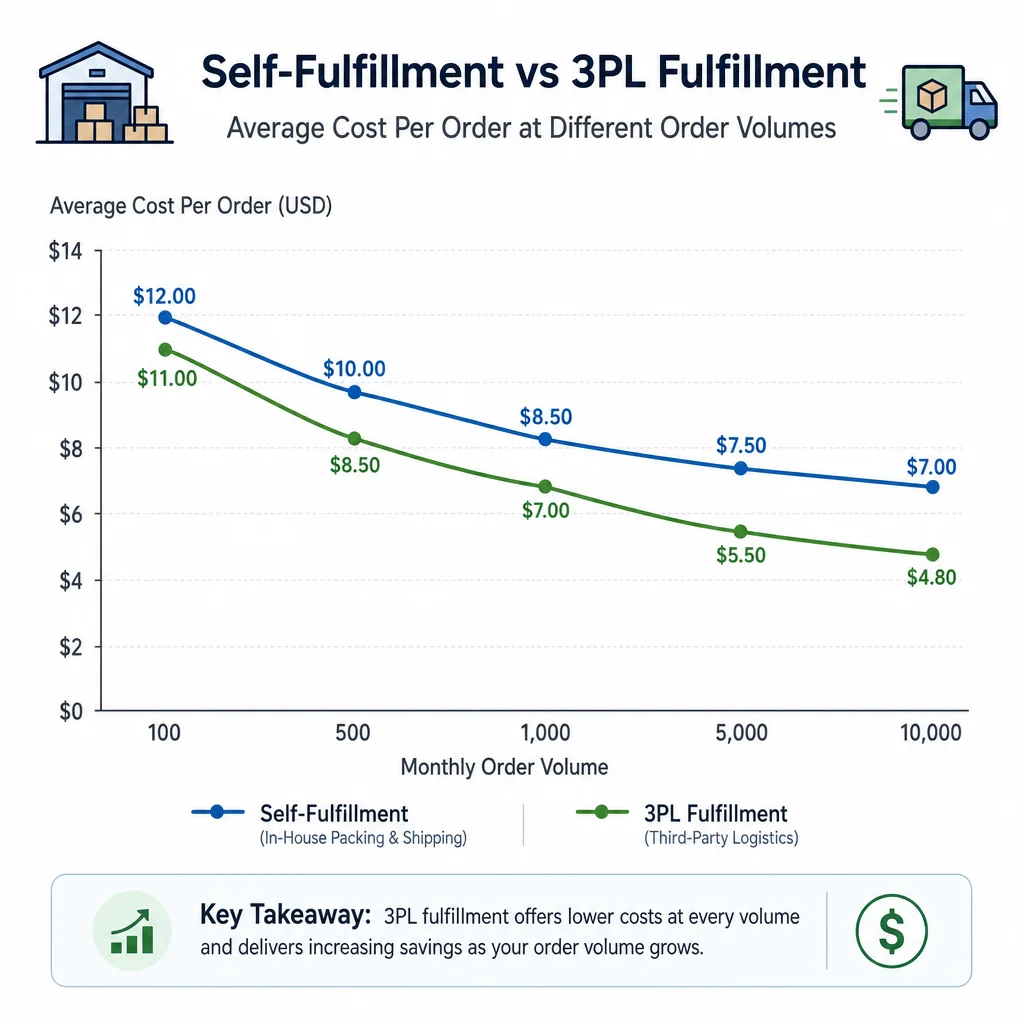
For most e-commerce businesses, the break-even point for outsourcing fulfillment occurs around 50-100 orders per month. Below this threshold, self-fulfillment may be more economical. Above it, the time savings and shipping discounts from 3PL services typically outweigh the fees.
Self-fulfillment costs to consider:
- Warehouse or storage space rent
- Packing materials and supplies
- Labor costs (including your own time)
- Retail shipping rates (20-40% higher than 3PL rates)
- Inventory management software
- Insurance and security
How to Choose the Right Fulfillment Partner
Selecting a fulfillment partner is a critical business decision that impacts customer satisfaction, operational efficiency, and profitability.
Key Evaluation Criteria
- Location and shipping zones – Fulfillment centers closer to your customer base reduce shipping costs and transit times. Businesses with national customer distribution benefit from multiple fulfillment locations or a centrally located facility.
- Technology and integrations – Verify that the provider integrates seamlessly with your e-commerce platform, marketplace accounts, and any other systems you use. Ask about API capabilities, inventory sync frequency, and reporting features.
- Scalability – Ensure the provider can handle your growth trajectory. Ask about their capacity during peak seasons, their largest clients, and their process for onboarding additional inventory or opening new warehouse locations.
- Order accuracy and speed – Request performance metrics including order accuracy rates (should be 99.5%+), average order processing time (same-day or next-day fulfillment), and on-time shipping rates.
- Pricing transparency – Avoid providers with hidden fees or complex pricing structures. Request a detailed fee schedule and ask for examples of total costs at different order volumes.
- Customer service and communication – Evaluate the provider’s responsiveness during the sales process. This often reflects the level of support you’ll receive as a client. Ask about dedicated account managers and support hours.
- Specialization and experience – If you sell specialized products (fragile items, perishables, hazmat), prioritize providers with relevant experience and certifications.
Red Flags to Avoid
- Providers unwilling to share client references or performance metrics
- Long-term contracts with high cancellation fees (3-6 month contracts are standard)
- Lack of real-time inventory visibility or reporting
- Poor online reviews mentioning inventory discrepancies or damaged shipments
- Minimum order volumes that significantly exceed your current needs
Questions to Ask Potential Partners
- What is your average order accuracy rate, and how do you measure it?
- How quickly do you process orders after receiving them from our platform?
- What happens if you damage or lose our inventory?
- Can you accommodate custom packaging or branded inserts?
- What are your peak season surcharges and capacity limits?
- How do you handle returns, and what information do you provide?
- What is your process for inventory cycle counts and reconciliation?
- Do you have backup power and disaster recovery procedures?
Integration with E-Commerce Platforms
Seamless integration between your e-commerce platform and fulfillment center is essential for operational efficiency and inventory accuracy.
Native Integrations
Most fulfillment centers offer pre-built integrations with major e-commerce platforms:
Shopify – Direct app integrations that sync orders, inventory, and tracking information automatically. Orders flow to the fulfillment center within minutes of customer purchase.
WooCommerce – Plugin-based integrations that connect WordPress stores to fulfillment center APIs.
BigCommerce – Native app marketplace integrations with automatic order routing and inventory updates.
Amazon Seller Central – API connections that fulfill Amazon orders through third-party fulfillment centers while maintaining Seller Fulfilled Prime eligibility.
Magento – Extension-based integrations for enterprise e-commerce platforms.
Multi-Channel Fulfillment
Businesses selling across multiple platforms (website, Amazon, eBay, Walmart, Etsy) need fulfillment centers that can aggregate orders from all channels and maintain unified inventory counts.
Multi-channel fulfillment prevents overselling by synchronizing inventory levels across all sales channels in real-time. When an item sells on Amazon, the available quantity automatically decreases on your Shopify store and other connected platforms.
Order Routing Rules
Advanced integrations allow merchants to set custom order routing rules:
- Route orders above a certain value to expedited shipping
- Split orders between multiple fulfillment centers based on inventory location
- Hold orders for quality inspection before shipping
- Route international orders to specific warehouses with customs expertise
Inventory Management
Real-time inventory synchronization is critical for preventing stockouts and overselling. Quality integrations update inventory levels every 15-30 minutes, with some providers offering real-time updates via webhooks.
Merchants can view inventory levels, set reorder points, and receive low-stock alerts through the fulfillment center’s dashboard or directly within their e-commerce platform.
Common Challenges and Solutions
Even with professional fulfillment services, merchants encounter operational challenges that require proactive management.
Inventory Discrepancies
Challenge: Inventory counts in the fulfillment center don’t match the merchant’s records, leading to overselling or stockouts.
Solution: Implement regular cycle counts (weekly or monthly) and reconcile discrepancies immediately. Use lot tracking and serial numbers for high-value items. Establish clear receiving procedures with photo documentation of incoming shipments.
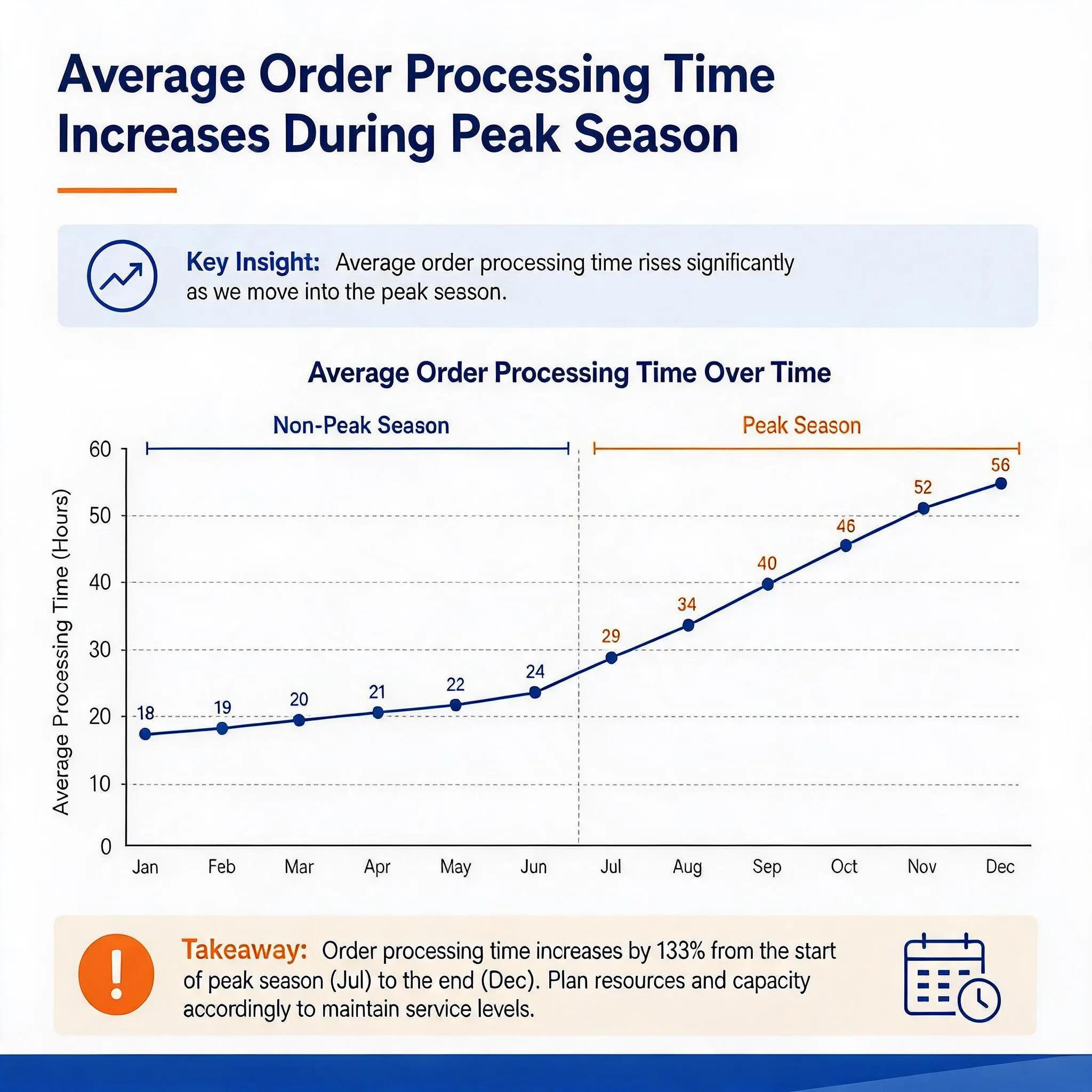
Slow Order Processing During Peak Seasons
Challenge: Order processing times increase during Black Friday, Cyber Monday, and holiday shopping periods, leading to delayed shipments and customer complaints.
Solution: Communicate with your fulfillment partner about expected volume increases at least 4-6 weeks in advance. Ensure adequate inventory is stocked before peak periods. Consider temporary storage fee increases to secure priority processing.
Damaged Products in Transit
Challenge: Products arrive damaged due to inadequate packaging, resulting in returns, refunds, and negative reviews.
Solution: Work with the fulfillment center to test packaging for your specific products. Use appropriate cushioning materials and box sizes. For fragile items, specify “fragile” handling and consider insurance for high-value shipments.
High Return Rates
Challenge: Excessive returns erode profitability and create reverse logistics complexity.
Solution: Analyze return reasons through fulfillment center reports. Common causes include inaccurate product descriptions, sizing issues, or quality problems. Address root causes rather than just processing returns. Implement quality control inspections for products with high return rates.
Communication Gaps
Challenge: Difficulty reaching the fulfillment center for urgent issues or lack of proactive communication about problems.
Solution: Establish clear communication protocols during onboarding. Identify your primary contact and escalation procedures. Schedule regular check-in calls (weekly or monthly) to review performance metrics and address concerns before they become critical issues.
Integration Failures
Challenge: Orders fail to sync, inventory counts become inaccurate, or tracking information doesn’t update properly.
Solution: Monitor integration health daily through your e-commerce platform’s logs. Set up alerts for failed order syncs. Maintain a backup manual order submission process for critical orders during integration outages.
Getting Started with Fulfillment Services
Transitioning to a fulfillment center requires careful planning and execution to avoid disruptions to your business.
Step 1: Evaluate Your Readiness (Week 1)
Calculate your current fulfillment costs including labor, materials, shipping, and storage. Determine your average monthly order volume and growth projections. Request quotes from 3-5 fulfillment providers and compare total costs at your current and projected volumes.
Action: Create a spreadsheet comparing self-fulfillment costs vs. 3PL costs at different order volumes.
Step 2: Select and Onboard a Provider (Weeks 2-4)
Choose a fulfillment partner based on pricing, location, technology, and specialization. Sign the service agreement and complete the technical integration setup. Most providers offer onboarding support to configure your account, set up platform integrations, and establish shipping rules.
Action: Schedule a kickoff call with your account manager to review expectations, timelines, and integration requirements.
Step 3: Ship Initial Inventory (Weeks 3-5)
Prepare your inventory for shipment to the fulfillment center. Create an advance shipping notice (ASN) detailing the products, quantities, and SKUs being sent. Use palletized shipments when possible to reduce receiving fees.
Action: Ship a small test batch (50-100 units) before sending your full inventory to verify receiving accuracy and storage procedures.
Step 4: Test and Validate (Week 5-6)
Place test orders through your e-commerce platform to verify the complete order flow from purchase to shipment. Check that inventory syncs correctly, orders route properly, and tracking information updates in your system.
Action: Place 5-10 test orders to yourself or team members, including single-item and multi-item orders.
Step 5: Go Live and Monitor (Week 6+)
Transition all order fulfillment to the new provider. Monitor performance metrics daily for the first 2-4 weeks, including order accuracy, processing speed, and inventory sync reliability. Address any issues immediately with your account manager.
Action: Set up a dashboard to track key metrics: orders fulfilled per day, order accuracy rate, average processing time, and inventory discrepancies.
Frequently Asked Questions
What is the minimum order volume required to use a fulfillment center?
Most fulfillment centers accept clients shipping as few as 50-100 orders per month, though some impose minimum monthly fees ($500-$1,000) for low-volume accounts. . The economic break-even point typically occurs around 50-100 orders per month, where 3PL costs become competitive with self-fulfillment when factoring in labor time and shipping discounts.
How long does it take to set up fulfillment services?
The typical onboarding timeline is 3-6 weeks from contract signing to processing your first orders. This includes technical integration setup (1-2 weeks), shipping initial inventory (1-2 weeks), receiving and inventory setup (3-5 days), and testing (1 week). Expedited onboarding is possible for urgent situations but may incur additional fees.
Can I use multiple fulfillment centers simultaneously?
Yes, many e-commerce businesses use multiple fulfillment centers to optimize shipping costs and delivery speed. This strategy, called distributed fulfillment, places inventory closer to regional customer concentrations. The complexity lies in inventory allocation and order routing, which requires sophisticated software or a fulfillment partner with multiple warehouse locations.
What happens if the fulfillment center loses or damages my inventory?
Reputable fulfillment centers carry insurance to cover lost or damaged inventory. Review the provider’s liability terms in the service agreement, which typically limit liability to the wholesale cost of the product (not retail value or lost profit). For high-value inventory, consider purchasing additional insurance. Document inventory condition with photos when shipping to the fulfillment center.
How do fulfillment centers handle international shipping?
Most fulfillment centers offer international shipping through partnerships with carriers like DHL, FedEx International, and USPS International. However, customs documentation, duties, and taxes add complexity. Some 3PLs specialize in international fulfillment and can handle customs brokerage, landed cost calculation, and compliance with destination country regulations. International shipping costs are significantly higher than domestic, typically $25-$75+ per package depending on destination and weight.
Can I switch fulfillment centers if I’m unhappy with my current provider?
Yes, though the transition requires careful planning to avoid order fulfillment disruptions. Most service agreements have 30-90 day termination notice periods. Plan to overlap providers for 2-4 weeks during the transition, maintaining inventory at both locations until the new provider is fully operational. Request a final inventory count and reconciliation from your outgoing provider before closing the account.
Do fulfillment centers offer branded packaging?
Most fulfillment centers accommodate custom packaging including branded boxes, tissue paper, stickers, thank-you cards, and promotional inserts. Setup fees ($200-$500) may apply for custom packaging programs. Per-order costs increase by $0.50-$2.00 depending on packaging complexity. Provide packaging materials to the fulfillment center, or they can source materials on your behalf (typically at a markup).
Conclusion
Fulfillment center services have evolved from a luxury for large e-commerce businesses to an essential infrastructure component for companies at all growth stages. By outsourcing warehousing, order processing, and shipping to specialized 3PL providers, merchants gain access to enterprise-level logistics capabilities without capital investment in facilities, staff, or technology.
The key to successful fulfillment outsourcing lies in selecting a provider that aligns with your product type, order volume, and growth trajectory. Prioritize partners with robust technology integrations, transparent pricing, and proven track records in your industry. Start with a small inventory test before committing your full product catalog, and maintain close communication during the onboarding period.
As e-commerce continues to grow and customer expectations for fast, accurate delivery intensify, fulfillment centers will remain critical partners in delivering the seamless shopping experiences that drive customer loyalty and repeat purchases. The businesses that thrive will be those that view fulfillment not as a cost center to minimize, but as a strategic advantage that enables growth and customer satisfaction.
Ready to explore fulfillment options? Start by calculating your current fulfillment costs and requesting quotes from 3-5 providers to compare pricing and capabilities at your order volume.
Continue Learning
Related Topics:
-
Shopify Dropshipping Fulfillment: How to Connect Your Store to a 3PL Fulfillment System
- Beyond Software: Why Dropshipping Supplier Platforms with Storefront Integration Fail Without Physical Infrastructure
-
3PL Dropshipping: How to Sell on TikTok Shop & Amazon Without Getting Banned
Tools & Resources: