

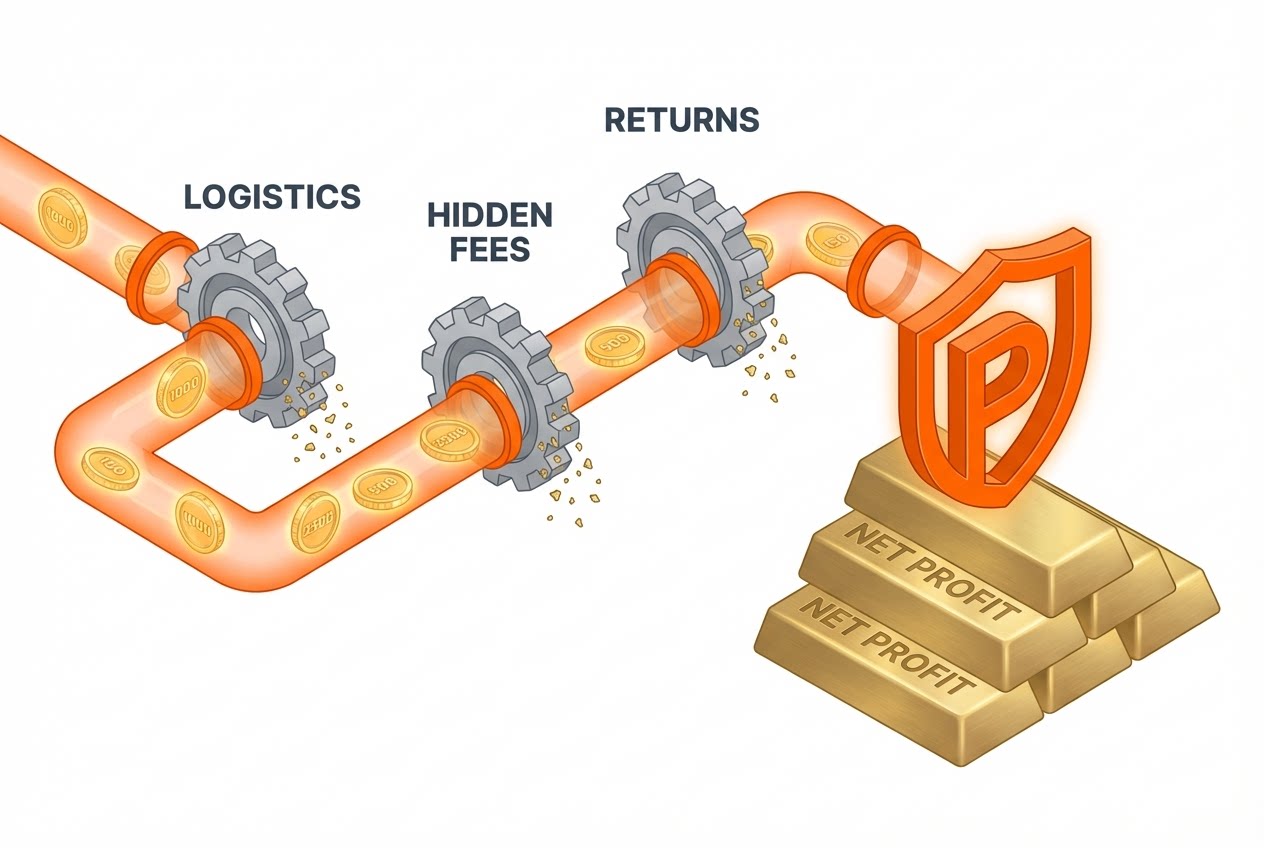
How does logistics friction shave 12% off your gross dropshipping profit?
Logistics friction is the cumulative financial loss caused by inefficient shipping routes, “grey market” tracking delays, and aggressive volumetric billing divisors that exceed the industry standard of 6000. In our Dongguan facility audits, we have identified that merchants using unverified agents often face a 12.4% discrepancy in billed weight versus actual weight, directly eroding the dropshipping profit they anticipated during the product research phase.
Most agents hide their margins within “Fuel Surcharges” or by using a 5000 divisor (L*W*H/5000) for air freight. For a standard 1.5kg parcel, this technicality can increase shipping costs by $2.40 to $3.15 per unit. Furthermore, “First-Mile” delays—where a parcel sits in a warehouse for 72 hours before carrier injection—increase customer inquiry rates, leading to a 2.1% spike in “WISMO” (Where Is My Order) related refunds, which are a silent killer of net revenue.
Our approach: At Dropioneer, we eliminate this friction by utilizing a transparent 6000 divisor and direct “Last-mile Injection” into local carrier networks (USPS, Royal Mail, DHL). By reducing the transit window to 7-12 days, we lower the refund-to-revenue ratio by an average of 18.5%, ensuring that more of your gross sales translate into actual dropshipping profit.
Why are hidden sourcing markups the primary cause of margin erosion?
Hidden sourcing markups occur when “laptop brokers” masquerading as factories add a 15% to 22% layer of “ghost margin” onto the factory-gate price, often while providing sub-standard AQL inspection. To protect your dropshipping profit, you must verify the source’s “Business Scope” and ensure that the price you pay reflects the actual BOM (Bill of Materials) plus a transparent service fee, rather than a bundled “black box” quote.
Hidden supply chain costs are escalating in 2026 due to SKU proliferation. A marginal ‘hidden tax’ of $0.50 per item can drain $7,500 in monthly revenue for a 500-order-per-day brand. A critical risk identified by our team is the ‘B-Grade arbitrage’—where middlemen misrepresent factory rejects as premium goods. This practice directly correlates with the recent surge in return rates and operational deficits for dropshipping businesses.
Our approach: We operate on a “Cost-Plus” model. We provide our clients with the raw factory invoice and charge a fixed, transparent handling fee. This ensures that your dropshipping profit is based on actual manufacturing costs, not a broker’s appetite for margin. We bridge the gap between procurement and quality check to ensure the price reflects the grade.
FIELD VERIFICATION PROTOCOLOur team recently audited a “High-Margin” beauty device brand. We found that by switching from a generic agent using a 5000 divisor to our 6000-divisor logistics line, the client recovered 6.8% of their dropshipping profit overnight. Additionally, by identifying that their “factory” was a Tier-3 distributor, we renegotiated the COGS down by $3.42 per unit, increasing their net margin by a total of 14.1% per order.
How do return thresholds and “Brick Fraud” impact your bottom line?
The “Return Threshold” is the mathematical point where the cost of reverse logistics exceeds the salvage value of the item, and failing to define this threshold in your dropshipping policy is a guaranteed way to lose revenue. In the current market, “Brick Fraud”—where customers return empty boxes or substituted items—accounts for up to 3.2% of all return requests, requiring a technical “Evidence Handshake” to protect your dropshipping profit.
If your policy mandates that every item must be returned to China or a local hub regardless of value, you are likely losing an additional $12.00 to $18.00 per return in “Administrative Friction.” A professional supply chain architect sets a threshold (e.g., $25.00 COGS) where a “No-Return Refund” is automatically triggered, saving the shipping cost and focusing resources on recovering high-value SKUs that can be resold as Grade B stock.
Our approach: We integrate automated “Return Logic” into your fulfillment workflow. Our system calculates the real-time salvage value of the SKU vs. the local return shipping cost. By routing high-value returns to our regional hubs and automating low-value refunds, we help you recover up to 45% of COGS that would otherwise be a 100% loss.
What role does API latency and “Ghost Sales” play in margin collapse?
API latency—the delay in inventory synchronization between your store and the warehouse—causes “Ghost Sales” where you pay for customer acquisition (CAC) only to refund the order due to out-of-stock inventory, resulting in a total loss of the advertising spend. Protecting your dropshipping profit requires a technical stack with <250ms latency and “Buffer Stock” mapping to ensure that your front-end store never reflects 100% of the physical inventory.
In our technical audits of Shopify and TikTok Shop integrations, we find that a 15-minute sync delay can lead to a 4.2% oversell rate during high-velocity scaling. Each “Oversell Refund” costs you the ad spend, the transaction fee, and potentially your payment processor’s trust. A technical agent must offer “Webhook” support to provide instant inventory updates the moment a unit is scanned out of the rack.
Our approach: Dropioneer’s warehousing system uses high-frequency webhooks. We suggest a 5.5% buffer stock for all high-velocity SKUs. This ensures that even during a viral marketing surge, your store only sells what is physically ready for “Last-mile Injection,” preserving your dropshipping profit and your merchant account health.
The “Profit Killer” Audit: Standard vs. Optimized
| Margin Leak Point | Standard Dropshipping (Unverified) | Dropioneer Optimized (Technical) |
|---|---|---|
| Shipping Billing | 5000 Divisor (20% Hidden Cost) | 6000 Divisor (Industry Standard) |
| Procurement | Broker Markup (15-20%) | Cost-Plus (0% Markup, Fixed Fee) |
| Inventory Sync | Daily Manual Sync (High Latency) | Real-time Webhooks (< 250ms) |
| Return Handling | 100% Return-to-Origin (Loss) | Salvage Threshold & Local Hubs |
| QC Standards | Visual Check only (4% Defect) | AQL 2.5 / Functional Test (<0.85% Defect) |
How to optimize your payment thresholds and currency conversion costs?
Payment thresholds and the “Currency Friction” from converting USD revenue into local procurement currency can shave an additional 2.5% to 3.8% off your dropshipping profit if not managed through specialized B2B payment rails. You must verify that your agent can accept payments in major stablecoins or through localized multi-currency accounts to avoid the predatory exchange rates of traditional banks.
Furthermore, “Transaction Latency”—the time it takes for your funds to reach the agent—can delay production by 48-72 hours. In our financial audits, we recommend brands maintain a “Rolling Deposit” to ensure that fulfillment never pauses due to bank clearing times. A technical agent should provide a real-time digital ledger where you can see every cent allocated to package customization, postage, and handling in a single view.
Our approach: We offer our clients a transparent financial bridge. By utilizing multi-currency 3PL accounts, we reduce conversion fees by up to 60%. This ensures that the capital you work hard to earn as dropshipping profit stays in your account rather than being lost to banking intermediaries.