


Prep is the least glamorous part of selling on Amazon and the most common reason a shipment gets refused at the dock. A unit that is undamaged, correctly manufactured and perfectly priced will still be turned away if the barcode sits on the wrong surface or the polybag has no suffocation warning. Sellers usually learn this the expensive way: a pallet sits in a warehouse in another country while the listing goes out of stock.
The work itself is mechanical. The decision that matters is where you do it. A 3PL that already holds your stock can prep it before it moves, a dedicated prep center can prep it after it moves, and both charge per unit. This guide lays out what Amazon actually enforces, what each route costs line by line, and the volume at which the answer flips.
What Amazon Actually Rejects
Amazon publishes its prep requirements in detail, and the rejections cluster around a short list. Each unit needs a scannable barcode that matches the listing: an FNSKU label over the original barcode for commingled inventory, or the manufacturer barcode when you are eligible for it. The label has to sit flat on the unit or on the outside of the bag, not on a curved surface where a scanner cannot read it.
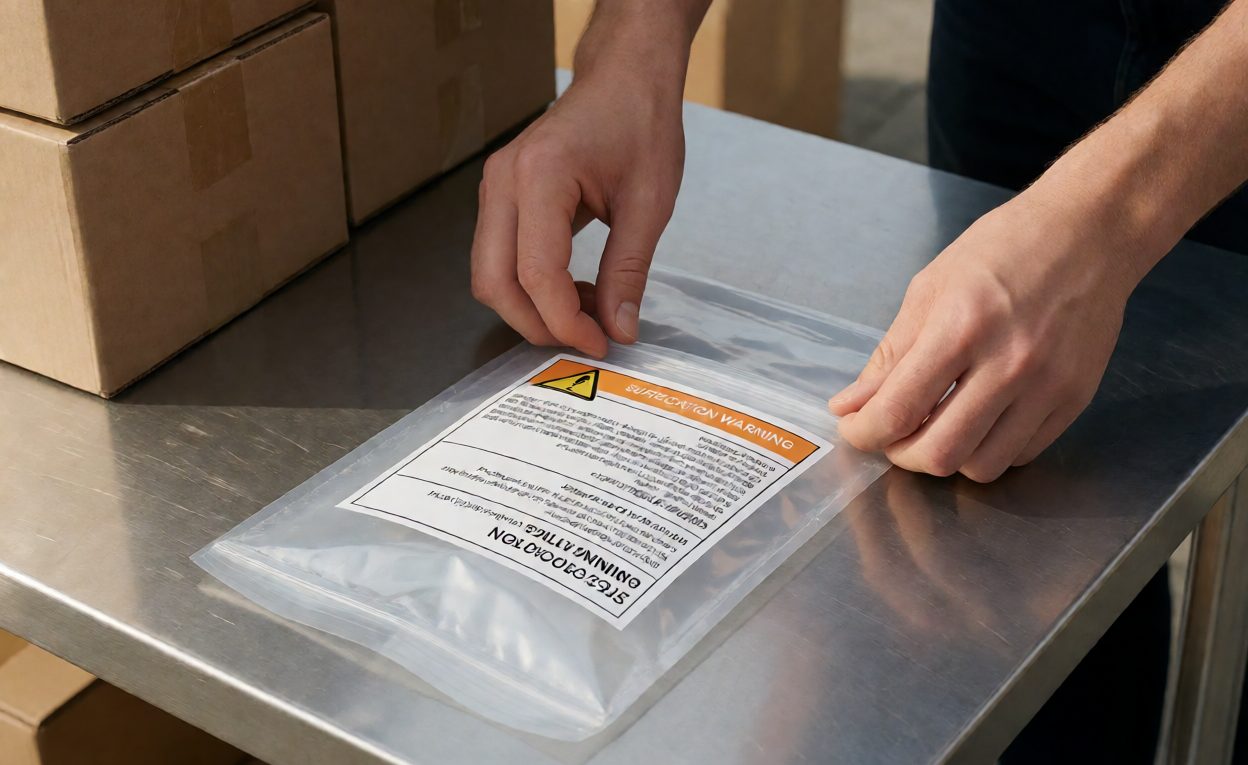
Loose units that could be scratched, or that are sold as sets, need poly bagging. Bags must carry a suffocation warning when the opening is five inches or larger, and the bag needs a vent hole if it is sealed tight enough to trap air. Sharp or fragile items need bubble wrap instead of a bag. Sets that Amazon sells as a single ASIN must be bundled so the components cannot separate in the bin, usually with a shrink band or a labelled bag rather than tape.
- Barcode: FNSKU label, printed clean, covering the original barcode, readable on a flat surface.
- Poly bag: correct thickness, suffocation warning, vent hole where required, item centred so the barcode is not folded.
- Bundles: components physically joined, labelled as one sellable unit, no loose pieces inside the bag.
- Expiry-dated goods: lot and expiry printed in the format Amazon expects, on the unit and the carton.
- Cartons: one FBA box ID label set, no other barcodes visible, carton weight and size inside the limits.
None of this is difficult. All of it is easy to get wrong at scale, which is why the failure rate at a low-volume in-house operation runs far higher than at a prep operation that does nothing else. An inspection workflow that catches defects before labelling is the natural companion to prep, because labelling a defective unit only makes the defect more expensive to fix.
Three Places to Do the Same Work
In-house makes sense only while you can stand at the table yourself. Labour is cheap until it competes with your selling time, and the moment you hire, you inherit training, error rates and a second location to manage.
At your 3PL is the option most cross-border sellers land on, because the stock is already there. The container arrives, the units are received, and prep happens in the same building before the pallet is rebuilt for Amazon. There is no second freight leg, no second receiving count, and no argument about which party damaged what. The trade-off is attention: a general 3PL runs prep as one service among many, and the quality of the labelling depends on how well you specified it.
At a dedicated prep center wins on consistency and on Amazon-specific knowledge. Prep centers live inside the FBA rule set, catch requirement changes quickly, and often hold appointments and carrier relationships that a general warehouse does not. The cost is a second inbound leg and a second receiving event, which is real money on heavy or bulky goods.
The Fee Stack, Line by Line
Quotes are rarely comparable because they bundle different things. Ask for a per-unit price for each operation and compare like for like. Typical market ranges for China-based and US-based prep look roughly like this.
- FNSKU labelling: USD 0.10 to 0.25 per unit, higher if labels must be printed per unit rather than applied from a roll.
- Poly bagging: USD 0.15 to 0.35 per unit including bag and warning label, more if a printed bag is required.
- Bubble wrap: USD 0.30 to 0.80 per unit depending on wrap layers.
- Bundle assembly: USD 0.50 to 2.00 per set, driven by component count and whether a shrink band is used.
- Carton labelling and sealing: USD 0.50 to 1.00 per carton.
- Inspection: USD 0.10 to 0.40 per unit, or a flat fee per lot at AQL sampling levels.
Then add the costs that do not appear on the prep invoice: the inbound freight leg to the prep center, the second receiving count, the extra week of transit, and the inventory carrying cost of stock sitting in the wrong building. A prep quote that looks 30 percent cheaper often loses on these four lines.
The Cost Math on a 500-Unit Shipment
Take 500 units across five SKUs, 100 units each, all requiring an FNSKU label and a poly bag, packed into 25 cartons. At a 3PL already holding the stock, label plus bag at USD 0.45 per unit comes to USD 225, carton work at USD 0.80 per carton adds USD 20, and inspection at AQL normal adds roughly USD 100. Total near USD 345 with no extra freight.
The same job at a prep center charging USD 0.85 per unit comes to USD 425, plus the cost of moving 25 cartons from the 3PL to the prep center. On a pallet-sized move inside the same metro that might be USD 120 to 180; across a state line it is more. The prep center is now 60 to 120 percent more expensive for identical output.
Flip the volume. At 5,000 units the per-unit gap of USD 0.40 becomes USD 2,000, while the extra freight leg stays roughly flat because you are moving full pallets. At that point a prep center that preps faster and with fewer rejections is usually the cheaper option even at a higher unit price, because a rejected inbound shipment costs more than the prep difference: storage at Amazon, reshipping, and a listing that goes dark for two weeks.

Where Prep Errors Actually Come From
Almost every prep failure traces to one of four causes: an ambiguous work order, a barcode printed at the wrong size, a bag sealed over the label, or a unit counted twice. All four are specification problems, not skill problems. The fix is a written prep specification per SKU with a photo of a correctly prepped unit attached, plus a first-article check before the run starts and a sampled check at the end.
Ask for photo evidence at three points: the first prepped unit, a mid-run carton, and the finished pallet with labels visible. Photos are cheap and they settle disputes instantly. If your provider resists sending them, that tells you something about how the account will be managed. The storage and SLA terms in your 3PL contract also matter here, because prep that happens late is prep that misses the appointment window.
Technical Background
Retail barcodes and the labels applied on top of them are governed by standards rather than by Amazon alone. The GS1 system defines the symbologies and data structures behind the UPC and EAN codes printed on retail packaging, which is why a resized or re-rendered barcode can fail a scanner even when it looks correct to the eye. Barcode readability depends on module width, quiet zones and contrast, and a label printed at low resolution on a thermal printer degrades exactly in those properties.
The reason prep sits naturally inside a warehouse operation is that third-party logistics providers already run receiving, put-away and value-added services on the same floor. Prep is a value-added service in the literal sense: it adds handling and information to a unit without changing what the unit is. Once you frame it that way, the question stops being “who is cheapest per label” and becomes “where in the flow does the labelling step add the least handling”.

A Decision Checklist
Work through these in order and the choice usually makes itself.
- Is the stock already sitting in a 3PL that offers prep? If yes, prep there unless quality has already failed twice.
- Is your volume above roughly 2,000 units per shipment? Above that, price a dedicated prep center properly, including the extra freight leg.
- Does the product need special handling, such as fragile, sharp, expiry-dated or bundled sets? Special handling favours a specialist.
- Can you write a per-SKU prep specification with a reference photo? If not, fix that before choosing a provider, because no provider can guess.
- What is your reject rate today? Anything above two percent is a specification problem you will carry to the next provider.
- How long is the appointment lead time at the fulfillment center, and does the provider book it or do you? Carton dimensions and dim weight decide both the freight cost and whether the carton clears the size limits.
Can a 3PL apply FNSKU labels instead of a prep center?
Yes. Applying FNSKU labels, poly bagging and carton labelling are standard value-added services at most 3PLs. What varies is the quality control around them, so specify the work in writing and check the first article.
Does Amazon charge for prep if a shipment arrives unprepared?
Amazon may apply prep or unplanned service fees, or refuse the shipment depending on the issue. Either way the cost lands on you, and a refusal also costs storage and reshipping. Assume unprepared shipments are your expense.
What is the difference between FNSKU and manufacturer barcode?
The FNSKU is Amazon’s own identifier applied over the retail barcode, used for commingled inventory. The manufacturer barcode lets Amazon track your units by the original UPC or EAN and is available under conditions set by Amazon.
Do poly bags always need a suffocation warning?
When the bag opening is five inches or larger, yes. Smaller bags are usually exempt. A vent hole is required when the bag could trap air and create a balloon effect that damages the seal.
Where should the barcode sit on a poly bagged unit?
On a flat, visible area outside the bag, not folded over an edge and not covered by a second label. If the bag wrinkles over the code, the scanner fails and the unit is treated as unlabelled.
Is prep at the 3PL cheaper than at a prep center?
Usually yes at low to mid volume, because you avoid a second inbound freight leg and a second receiving count. Above roughly 2,000 units per shipment the per-unit gap can outweigh the extra freight.
How do I stop prep errors repeating?
Write a per-SKU spec with a photo, require a first-article check, and ask for photo evidence on the first unit, a mid-run carton and the finished pallet. Most errors are specification errors, not skill errors.