If you’ve been exploring ecommerce fulfillment options, you’ve almost certainly come across the term 3PL. But what exactly does it mean — and could it be the solution your online store has been waiting for?
In this guide, we’ll break down exactly what a 3PL is, how it works, the different types available, and how to decide if one is right for your business in 2026.
What Is a 3PL?
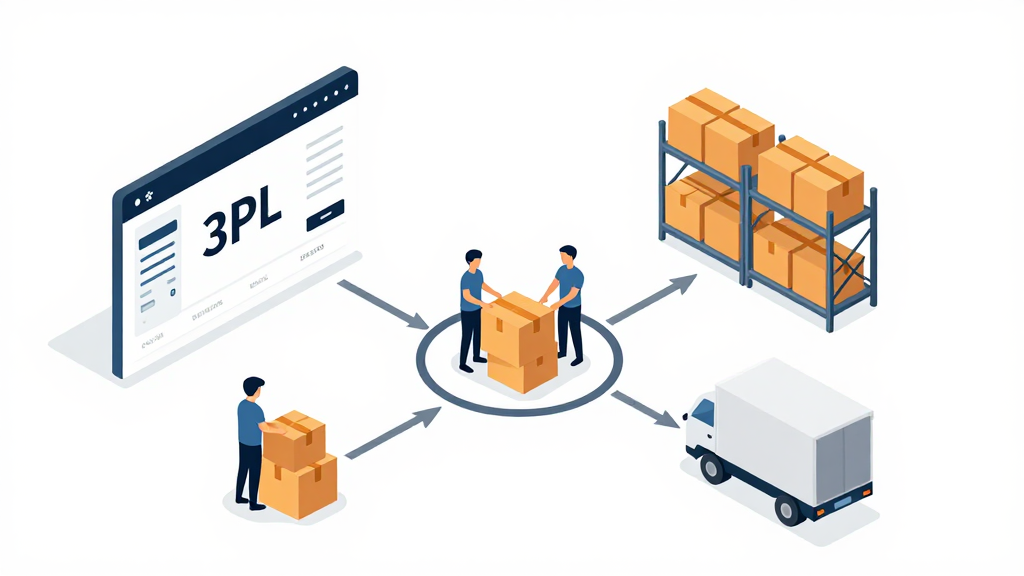
A 3PL — short for third-party logistics — is an external company you hire to handle some or all of your supply chain and fulfillment operations. Instead of storing products yourself, packing boxes in your garage, or negotiating shipping rates alone, a 3PL takes over those backend tasks on your behalf.
The core services a 3PL typically provides include:
- Warehousing — storing your inventory in their fulfillment center
- Order picking & packing — preparing individual orders for shipment
- Shipping & last-mile delivery — dispatching packages to your customers worldwide
- Inventory management — tracking stock levels and alerting you when to reorder
- Returns processing — handling customer returns and restocking items
Some 3PLs go further, offering value-added services like quality inspection, custom brand packaging, product kitting, and dedicated customer support — making them a true end-to-end fulfillment partner rather than just a warehouse.
Why Is 3PL Important in 2026?
The global 3PL market is projected to reach USD $1.54 trillion in 2026, growing at roughly 9% annually. That growth reflects a fundamental shift in how ecommerce businesses operate.
Over 60% of ecommerce shipments globally are now handled by 3PL providers. Even among the world’s largest companies, more than 80% of Fortune 500 firms rely on at least one 3PL partner to manage their logistics. For independent online sellers, outsourcing fulfillment has become the default — not the exception.
As online retail grows more competitive, customers expect fast delivery, professional packaging, and seamless returns. Building all of that infrastructure in-house requires enormous capital. Partnering with the right 3PL gives you access to that infrastructure immediately — at a fraction of the cost.
How Does a 3PL Work?
The typical 3PL fulfillment cycle follows these steps:
- You send inventory to the 3PL warehouse (or, in a dropshipping model, your supplier ships directly to the 3PL).
- The 3PL receives and stores your products, logging each SKU into their warehouse management system.
- A customer places an order on your Shopify, WooCommerce, or other storefront.
- The order is automatically forwarded to the 3PL via platform integration.
- The 3PL picks, packs, and ships the order — often within 24 hours — under your brand name.
- Tracking information is sent to you and your customer automatically.
- Returns are handled by the 3PL if needed, with items restocked or disposed of per your instructions.
The best 3PL partners integrate directly with your store platform, meaning the entire process is automated after the initial setup.
Types of 3PL Providers
Not all 3PLs are built the same. Here’s a quick overview of the main categories:
Standard Fulfillment 3PL
The most common type. These providers handle warehousing, pick-and-pack, and shipping for brands that already source and own their inventory. Best for established sellers who have confirmed product-market fit and need to scale operations.
Dropshipping 3PL
A dropshipping-focused 3PL sits at the intersection of supplier and fulfillment provider. You don’t pre-purchase inventory — orders are fulfilled on demand. This model is ideal for new sellers who want to launch without upfront inventory costs, or experienced sellers testing new product lines with zero financial risk.
Freight & Transportation 3PL
Primarily focused on moving goods between locations — manufacturer to port, port to warehouse, or across borders. These providers specialize in freight forwarding, customs clearance, and bulk transport rather than individual order fulfillment.
Integrated / Full-Service 3PL
An all-in-one provider handling everything from sourcing and quality inspection through to branded packaging, fulfillment, and customer support. Ideal for sellers who want a single trusted partner managing their entire supply chain.
3PL vs. Dropshipping: What’s the Difference?
This is one of the most common points of confusion for ecommerce sellers. Here’s the key distinction:
- Traditional 3PL — You purchase and own the inventory. The 3PL stores and ships it for you. You carry the financial risk of unsold stock.
- Dropshipping — You don’t own inventory at all. Products are sourced and shipped on demand. No upfront stock investment required.
- Dropshipping 3PL (hybrid) — A provider like Dropioneer combines both models: acting as your sourcing agent, quality checker, warehouse operator, and fulfillment partner — all without requiring you to pre-purchase bulk inventory.
For most new and mid-stage ecommerce sellers, the dropshipping 3PL model offers the best of both worlds: professional fulfillment infrastructure with minimal financial risk.
Key Benefits of Using a 3PL for Your Ecommerce Store
1. Zero Warehouse Overhead
Leasing warehouse space, hiring fulfillment staff, and purchasing equipment can cost tens of thousands of dollars before you ship a single package. With a 3PL, those costs are spread across their entire client base — you pay only for what you use.
2. Faster Shipping Times
Established 3PLs have existing carrier relationships and warehouses positioned close to key markets. This translates directly into faster delivery times and better customer satisfaction for your store.
3. Scalability On Demand
Whether you’re shipping 10 orders a week or 10,000, a 3PL scales with you. No need to hire more staff or rent larger premises when your volume grows — the 3PL’s infrastructure handles the increase automatically.
4. Professional Brand Packaging
Many 3PLs offer custom packaging options — branded boxes, inserts, tissue paper, and thank-you cards. This elevates the customer unboxing experience without you managing packaging logistics yourself.
5. Focus on What Matters
Your competitive advantage as a seller lies in marketing, product selection, and customer relationships — not in packing boxes. Outsourcing fulfillment to a 3PL frees up your time to grow the business.
How to Choose the Right 3PL for Your Business
When evaluating 3PL partners, focus on these key factors:
- Location and shipping reach — Does the provider have warehouses near your primary customer base? For global sellers, look for a 3PL with established international shipping routes.
- Fulfillment speed — What’s the order processing SLA? Industry-leading 3PLs process orders within 24 hours of receipt.
- Platform integrations — Confirm direct integration with your storefront (Shopify, WooCommerce, etc.) to enable automatic order syncing.
- Quality control — Does the 3PL inspect products before storage and before shipment? Critical when sourcing from overseas manufacturers.
- Branding options — Can you ship under your own brand name with custom packaging? Non-negotiable if you’re building a branded ecommerce business.
- Pricing transparency — Understand all fees upfront: receiving, storage, pick-and-pack, and outbound shipping. Hidden fees are a common pain point with lower-quality providers.
How Dropioneer Works as Your 3PL Partner
Dropioneer is a full-service dropshipping and fulfillment platform purpose-built for global ecommerce sellers. Operating from a 3,000 sqm warehouse in Shenzhen, China — the heart of the world’s most efficient manufacturing supply chain — Dropioneer handles every stage of your fulfillment process:
- ✔ Product Sourcing — Connect to verified manufacturers and suppliers
- ✔ Quality Inspection — Every product checked before it leaves our warehouse
- ✔ Warehousing & Storage — Secure, organized, and inventory-tracked
- ✔ 24-Hour Order Fulfillment — Orders processed within one business day
- ✔ Global Shipping — Delivered to your customers in 6–12 business days worldwide
- ✔ Custom Brand Packaging — Your logo, your unboxing experience
- ✔ Dedicated Support — A real team behind every order
Whether you’re launching your first Shopify store or scaling an existing brand, Dropioneer gives you enterprise-level fulfillment infrastructure without the enterprise-level overhead.
Get Started with Dropioneer — Free Consultation →
Frequently Asked Questions About 3PL
What does 3PL stand for?
3PL stands for third-party logistics. It refers to an external company that manages logistics functions — including warehousing, order fulfillment, and shipping — on behalf of another business.
What is the difference between a 3PL and a warehouse?
A warehouse simply stores goods. A 3PL is a full-service logistics partner that stores your inventory and actively manages order processing, packing, shipping, and returns — all as an integrated service.
Is dropshipping the same as using a 3PL?
Not exactly. Traditional dropshipping means products ship directly from your supplier to your customer. A 3PL typically requires you to own inventory. However, providers like Dropioneer combine both models — letting you run a zero-inventory dropshipping business with full 3PL-grade fulfillment quality.
How much does a 3PL cost?
Costs typically include receiving fees, monthly storage fees, per-order pick-and-pack fees, and outbound shipping. For dropshipping-model 3PLs, pricing is usually per-order with no storage commitment required.
When should I start using a 3PL?
Many ecommerce brands switch to a 3PL when they’re shipping 50+ orders per month and fulfillment is consuming several hours a day. For dropshipping sellers, a 3PL partner is valuable from day one — it removes the need to handle any physical logistics, regardless of order volume.
Can a 3PL ship internationally?
Yes — many 3PLs specialize in international fulfillment. Partnering with a China-based 3PL like Dropioneer means you’re already adjacent to the world’s largest manufacturing base, with global shipping networks delivering to customers in 6–12 business days.
Final Thoughts
A 3PL is more than just a warehouse with a courier contract. For ecommerce sellers building global brands without a physical logistics team, the right 3PL partner is the operational foundation that makes scaling possible.
Whether you want to eliminate the hassle of packing orders yourself, reduce shipping costs, improve delivery times, or launch a professional branded experience on a startup budget — partnering with a 3PL is one of the highest-leverage decisions you can make as an online seller.
Ready to see what a modern dropshipping 3PL looks like in practice? Explore Dropioneer’s fulfillment services and start shipping smarter today.