


Sourcing a full container from one factory is the easy logistics case: one pickup, one bill of lading, one customs entry. Most real catalogues are not like that. A typical bulk order spans three to six suppliers, none of whom fills a container alone. Shipping each supplier’s part separately as LCL, less than container load, costs more per cubic meter, adds handling at every consolidation point, and multiplies the documents, duties and delay risks of every shipment.
Consolidation, gathering several suppliers’ goods at an origin warehouse and loading them into one container, is the standard answer. The planning around it is what separates a container that sails on schedule from one that sits two weeks waiting for the last supplier.

Why Consolidation Beats LCL for Multi-Supplier Orders
LCL freight is priced per cubic meter with minimum charges, and it carries fees at both ends: origin CFS charges, destination de-consolidation fees, document fees and longer, less predictable transit because co-loaded freight waits at groupage hubs. Stack the arithmetic for a five-supplier order and LCL often costs more than a partly empty container, before counting the damage from extra handling.
- Rate economics. Once total volume crosses roughly half a container, a full container at a flat rate usually undercuts five LCL quotations, even with space to spare.
- Handling count. LCL freight is stuffed, unstuffed and restuffed at groupage warehouses. Every handling is a damage and loss opportunity that consolidated FCL freight never sees.
- Single customs entry. One container means one arrival notice, one entry and one set of terminal charges instead of five staggered arrivals.
- One schedule. All SKUs land together, so a launch or restock does not wait on the slowest of five independent shipments.

How a Consolidated Shipment Is Actually Assembled
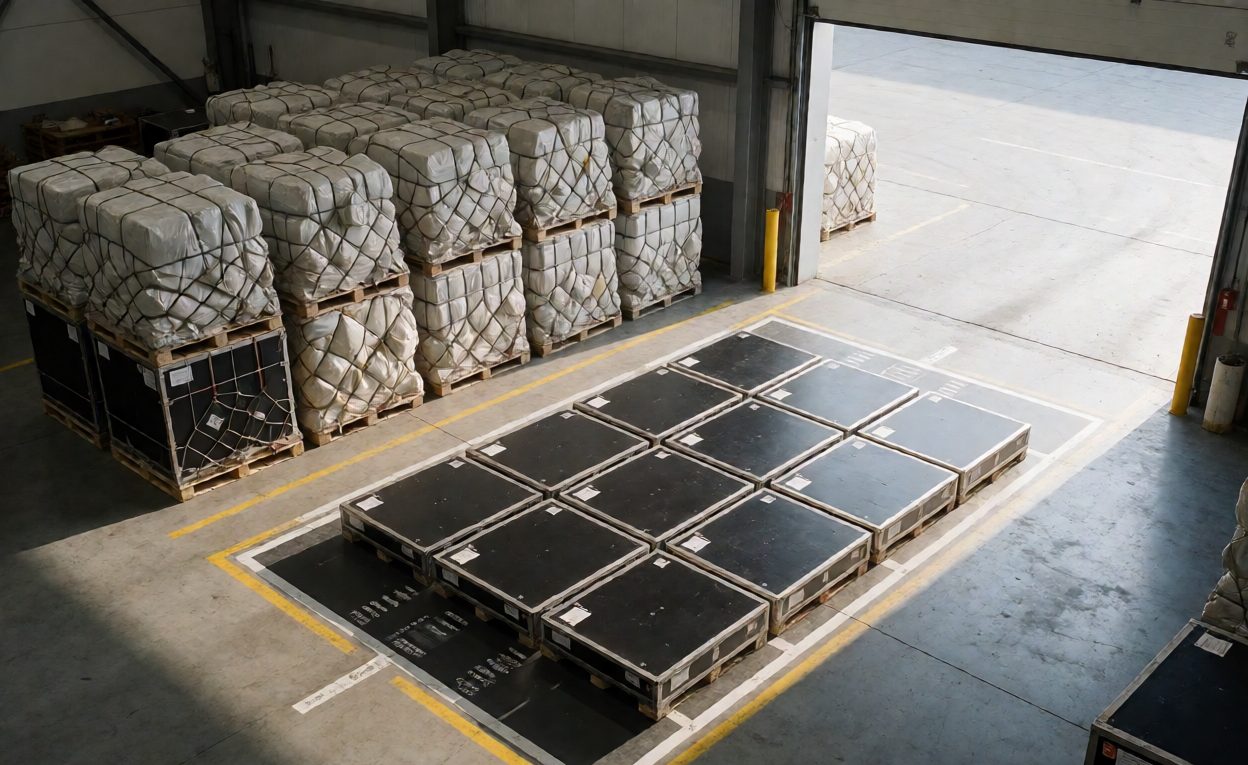
The mechanics run through a consolidation warehouse, usually the freight forwarder’s or your sourcing agent’s. Each supplier delivers finished, packed goods to that warehouse with a packing list and carton marks. The warehouse checks counts against purchase orders, photographs carton condition, and stacks goods by booking. Then the container is picked, loaded to a plan, weighed for the VGM declaration, and sealed.
The weak point is obvious: one late supplier holds the entire container. The countermeasures are contractual and calendar-based. Set each supplier’s delivery-to-warehouse deadline several working days ahead of the booking cutoff, put the cutoff in writing on every purchase order, and decide in advance what happens to the straggler, whether it ships LCL on the next groupage, waits for the next container, or moves by air if the calendar forces it.
Splitting the Container at Destination
At destination the container is destuffed at a warehouse, goods are sorted by SKU or destination, and each part forwards on its cheapest lane: parcel network for single orders, LTL for regional bulk, or zone-skipped linehaul for high-volume destinations. This is where multi-supplier becomes multi-destination: one ocean freight and one import entry amortized across every upstream SKU, then each part flowing down its own cost curve.
Which Suppliers Belong in the Same Container
- Compatible cargo. Heavy dense goods balance light bulky ones and fill both the weight and the cube. Keep moisture-sensitive goods away from anything that sweats, smells or leaks.
- Aligned readiness. Suppliers finishing the same week consolidate cleanly. Pairing a two-week factory with a six-week one means one of them waits in storage you are paying for.
- Compatible Incoterms. EXW or FCA suppliers deliver into the warehouse under your routing. Mixing in FOB or CIF suppliers changes who controls the booking and splits the shipment.
- Shared destination. Consolidation pays when everything clears at one port under one entry. Splitting destinations reintroduces the LCL problem on land.
Technical Background
The entire strategy rests on containerization, the standardization of cargo units that makes one box usable across ships, rails and trucks. The party who assembles groupage and books the move is described under freight forwarder, whose consolidation services are the commercial mechanism here. The delivery and responsibility splits between the parties along the way come from Incoterms, which decide who pays for each leg and where risk transfers.
Planning Rules and the Cost Math
Run consolidation as a rule set, not an improvisation. Fix booking cutoffs relative to sailing dates, fix supplier delivery deadlines relative to cutoffs, and fix a loading plan template that puts heavy cartons on the floor and light ones above with dunnage between layers. Review the per-CBM arithmetic quarterly, because LCL rates, container rates and destination fees move on different cycles.
Who pays for which leg at the consolidation warehouse follows directly from Incoterms on wholesale purchase orders, and the freight and duty pieces feed straight into landed cost calculation for wholesale imports. On the destination side, zone skipping bulk shipping rates is usually the cheapest onward lane for the largest volume share. And when a slipped supplier pushes the whole plan past a launch date, the fallback decision is covered in choosing between air and sea freight, which is the calculus you hope never to need but should have priced in advance.
Frequently Asked Questions
How full should a container be before consolidating into FCL?
Around 20 to 25 cubic meters is the usual crossover. Below that, LCL is often cheaper despite the higher per-CBM rate; above it, the flat container rate wins.
What is LCL and when is it still the right choice?
Less than container load is shared space in a consolidated box. It suits small shipments, urgent top-ups and orders below the FCL crossover, accepting extra handling and longer transit.
Who is responsible if one supplier’s goods damage another’s?
Liability follows packing quality and the loading plan records. Photos at the consolidation warehouse, agreed packing standards and cargo insurance resolve it; without them it becomes a dispute between buyers.
How much time does origin consolidation add?
A few working days for receiving and loading when suppliers meet deadlines, longer only when a straggler forces a wait. The cutoff schedule is what keeps it short.
Can different suppliers share one bill of lading?
Yes. The consolidator or your agent appears as shipper on a house or master bill covering all suppliers, and each supplier’s portion is tracked on its own packing list.
What is VGM?
Verified gross mass: the container’s total weight, declared before loading, as required by maritime safety rules. The consolidation warehouse weighs the stuffed container and files it.
How do I stop one late supplier from delaying everything?
Staggered deadlines ahead of the cutoff, a written penalty or exclusion rule, and a pre-agreed fallback for stragglers such as LCL or air on the next available departure.