

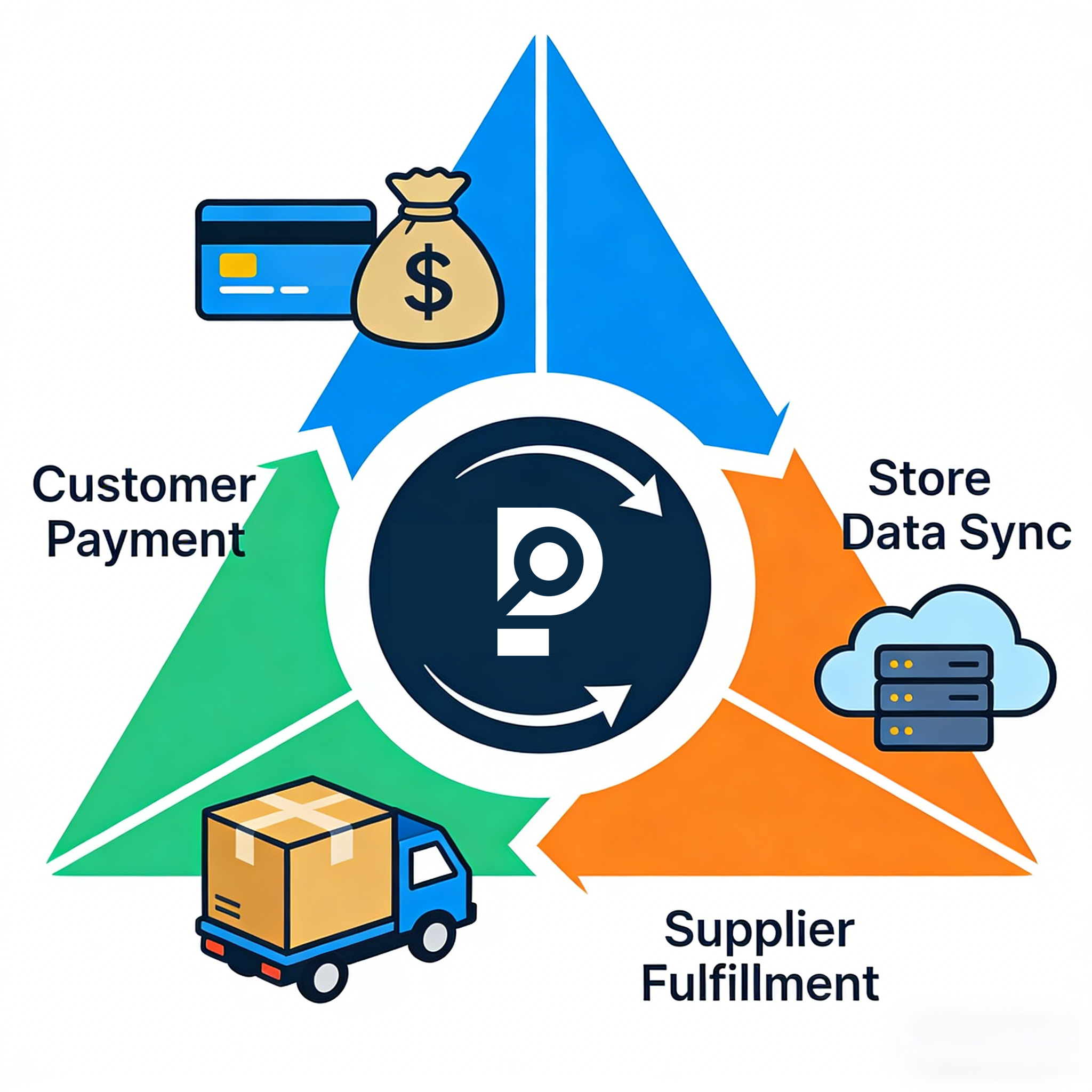
If you ask a beginner how dropshipping works, they will draw a simple diagram: Customer orders -> You order -> Supplier ships.
While physically true, this oversimplification ruins businesses. It ignores the two most critical lifelines of your store: Cash Flow and Data Integrity.
At Dropioneer, we manage the backend for high-volume sellers. We know that understanding the financial mechanics is just as important as the logistics. In this guide, we break down the invisible gears that turn a dropshipping store into a profitable machine.
The “Cash Flow Gap”: The Hidden Mechanics
Here is the reality that YouTube gurus rarely mention. When a customer buys a $50 product from your store, you do not have that $50 immediately.
- Step 1: The Hold. Stripe or PayPal processes the $50. They hold it for 3-7 days (or longer for new accounts) to prevent fraud.
- Step 2: The Expense. You must pay your supplier $15 for the product immediately to get it shipped. You cannot wait for the Stripe payout.
- Step 3: The Gap. You are now “out of pocket” $15. If you sell 100 units a day, you need $1,500 in working capital daily.
This is where having a trusted supplier becomes a financial asset. A reliable partner like Dropioneer processes orders fast enough to trigger tracking codes, which signals to PayPal/Stripe to release your funds sooner.
The Data Flow: Synchronization is Survival
Beyond money, dropshipping is a game of data transmission. If the data stops, the product stops.
Imagine you have 20 orders. You could manually type 20 addresses into AliExpress. But what if you have 200 orders? Manual entry leads to typos, lost packages, and angry customers.
How It Works Professionally:
We use seamless store sync technology. Here is the automated workflow:
| Time | The Event | The Dropioneer Action |
|---|---|---|
| 00:00 | Customer places order on Shopify. | System instantly pulls SKU & Address data. |
| 06:00 | Order processed in China. | Warehouse staff picks item and performs quality check. |
| 12:00 | Package handed to carrier. | Tracking number generated & uploaded to Shopify automatically. |
Why the “Trusted Supplier” is Critical for Operations
In this ecosystem, your supplier is the engine. If the engine stalls, the car (your business) stops, but you still have to pay for the gas (ads).
A trusted supplier does three things that random AliExpress sellers do not:
- Inventory Transparency: We tell you the real stock levels. If we say we have it, we have it. We don’t sell “ghost stock” that forces you to refund customers later.
- Shipping Truth: When we say 6-12 days shipping, we mean it. We don’t use fake tracking numbers just to satisfy the marketplace algorithms.
- Sourcing Agility: If a factory runs out of stock, our sourcing team immediately finds a backup factory to keep your fulfillment line moving.
The “Reverse” Flow: Returns and Disputes
Finally, understanding how dropshipping works means understanding what happens when it goes wrong.
In the amateur model, returns are a black hole. You refund the customer, and you lose the product.
In the professional model with Dropioneer, we help manage the dispute. If the carrier lost the package, we handle the claim. If the product was damaged, our previous quality inspection records help identify where the issue occurred. This protects your profitability.
Conclusion: It’s a System, Not a Magic Trick
Dropshipping isn’t magic. It is a complex system of moving money, data, and physical goods in perfect synchronization.
When you understand the mechanics of the “Cash Flow Gap” and “Data Sync,” you realize that you cannot do this alone. You need a partner who understands the machinery.
Ready to build a system that works? Contact Dropioneer today to streamline your operations.