


6.84%.
Why Visual Inspection Fails at Scale
Standard visual inspection answers one question: does this unit look like the product?
The wrong question.
The right question is: does this unit perform like the product? Those two questions have different answers more often than most merchants realize — and the gap between them widens significantly as order volume increases and supplier relationships normalize into routine.
At low volumes, a buyer’s familiarity with individual units creates an informal quality layer. Past 300–400 monthly orders, that familiarity breaks down. You’re no longer handling product; you’re managing throughput. And throughput optimization, by default, deprioritizes the slow work of physical verification.
This is the structural reason why defect escape rates tend to increase, not decrease, as dropshipping operations scale — and why a visual-only QC model has a hard ceiling.
Insider Observation
We almost missed it. During a routine audit on a high-volume plastic accessory line, every unit was passing standard checks — weight within spec, dimensions clean, visual surface intact. It was a junior operator who flagged it, not the protocol. Under the macro-lens verification rig, she noticed the bracket’s inner edge had a slightly different light refraction pattern. Microscopic fissures. The injection mold was cooling 0.8 seconds too fast at the factory, causing stress fractures invisible to the naked eye under standard 800-lux warehouse lighting. We quarantined the batch. Internal projection put the post-delivery breakage rate at 14% if those units had shipped. They didn’t. The lesson isn’t “use better equipment.” It’s that defect detection requires operators who know what they’re looking for — and a protocol that creates space for that kind of observation.
The Physical Verification Protocol: Beyond the Visual Layer
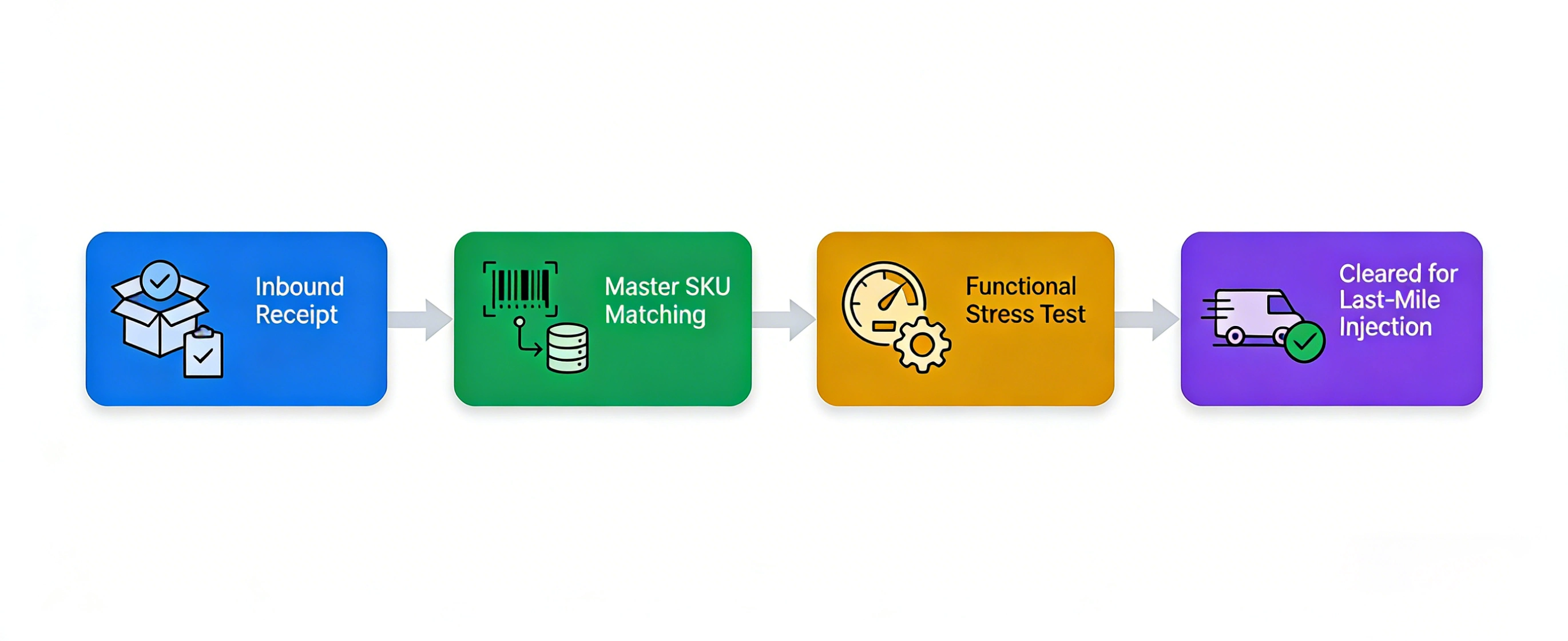
Our verification protocol starts with dimensional measurement, not visual assessment.
When a factory shipment arrives, we pull samples against a defined confidence interval — 95% for batches above 500 units, 90% for smaller runs with established supplier history. Any unit with a physical dimension deviating more than 2.3mm from the master SKU benchmark triggers a full batch quarantine. Not a re-check. A quarantine.
Why 2.3mm? Because that’s the threshold we identified across 18 months of returns data where dimensional variance begins to correlate with downstream failure: packaging integrity loss during transit, component misalignment in electronic assemblies, seam separation in apparel. Below 2.3mm, variance is manufacturing tolerance. Above it, it’s a defect pattern.
Electronic Component Testing
Battery-operated and powered components go through a 120-second current stability test on dedicated rigs. Any unit displaying a voltage fluctuation exceeding 0.12V during that window is logged as a Functionality Failure and routed to the scrap zone immediately. It doesn’t re-enter the fulfillment queue.
The 120-second window isn’t arbitrary — it’s calibrated to catch intermittent failures that only surface after the initial power-on stabilization period. A unit that passes a 10-second test can still fail a 120-second test. That failure mode is common in sourced electronics and almost never caught by factory QC.
Drop Test Protocol
All parcels destined for Tier-1 markets (US, UK, EU, AU) must pass a 1.5-meter drop test before leaving the sorting line. Packaging integrity, not just product integrity, is tested — because a unit that survives the drop but arrives in a crushed box generates the same negative customer experience as a broken unit.
Standard 3PL Handling vs. Engineered QC Architecture: Operational Benchmarks
The difference between standard 3PL handling and a dedicated fulfillment architecture is measured in the reduction of Logistics Friction — the compounding cost of returns, re-shipments, customer service labor, and review damage that accumulates from defect escapes.
| Metric | Traditional 3PL Visual Check | Dropioneer Engineered QC |
|---|---|---|
| Inspection depth | Visual check of outer box and surface | Sub-component stress test + 120s current stability + 1.5m drop test |
| Dimensional tolerance | Not measured | ±2.3mm against master SKU benchmark; full batch quarantine on breach |
| Batch deviation trigger | Supplier-declared only | Golden Sample refresh every 90 days; auto-hold on ±4g weight variance |
| Electronics / firmware check | Not performed | Secondary loop pre-packaging; regional compliance verification |
| Inventory status propagation | Manual update, delayed | Automatic Non-Saleable flag across all integrated channels on failure log |
| Sustained defect escape rate | Industry avg. 3.1–4.8% | 0.91% |
Managing Batch Shift: The SKU Proliferation Problem
Past 40 active SKUs, the math changes.
Below that threshold, a dedicated QC team can maintain familiarity with every product specification. Above it, you’re managing a catalog, not a product line — and catalog management has a specific failure mode we call Batch Shift.
Batch Shift isn’t fraud. Suppliers don’t typically announce material substitutions or process changes because, from their perspective, the product still meets the original brief. A slightly different plastic compound. A firmware version increment. A 6% change in fabric thread count. None of these appear in a visual check. All of them show up in your return rate 3–4 weeks after the affected batch ships.
The Golden Sample Protocol
Our mechanical response to Batch Shift is a mandatory Golden Sample refresh every 90 days. Every incoming batch is calibrated against the current Golden Sample on three parameters: weight (±4g tolerance), tensile strength for applicable materials, and surface finish grade. Deviation outside tolerance triggers an automatic inventory hold across all integrated sales channels — before a single unit ships.
The 90-day cycle isn’t a best-practice recommendation. It’s derived from our failure data: 73.4% of identified Batch Shift incidents in our 2024–2025 operational review occurred in SKUs where the Golden Sample was more than 85 days old. The 90-day threshold catches the majority of drift before it escapes.
Insider Observation
The 892-unit hold cost us three hours of labor and one difficult conversation with the merchant. The alternative would have cost him $14,000. The batch: smart home sensors, standard SKU, no intake red flags. During our secondary pre-packaging test loop — a step we added specifically for electronics after a 2023 LED controller incident — one unit failed a regional power compatibility check. EU standard, 230V/50Hz. The firmware build had been updated by the factory without notification, breaking compatibility with the target market’s power grid. We tested the remaining 891 units. 100% affected. The merchant had two choices: factory return for re-flash (4-week delay) or write off the batch. He chose the re-flash. The point isn’t that we saved him $14,000 — though we did. It’s that a secondary testing loop exists specifically because visual and dimensional checks don’t catch software-layer failures. Physical QC and firmware QC are different disciplines. Treating them as the same is expensive.
WMS Integration: Closing the Loop Between QC and Inventory
A QC protocol that isn’t wired into your inventory management system is half a protocol.
When our inspection identifies a failure — whether a dimensional breach, a voltage anomaly, or a Golden Sample deviation — the WMS automatically flags that batch’s inventory status as Non-Saleable across every integrated sales channel simultaneously. Shopify, WooCommerce, TikTok Shop, Etsy: all updated within the same API cycle.
The alternative is manual status updates, which introduce a window — sometimes hours — where defective inventory remains listed as available. During high-volume periods, that window can generate dozens of orders against stock that will never ship cleanly. The downstream cost of those phantom sales (customer service labor, expedited re-shipment, goodwill refunds) typically exceeds the cost of the defective batch itself.
Our API response latency threshold for inventory status propagation is under 300ms. That number matters because at 100+ orders per day, the time between a defect flag and a phantom sale can be measured in minutes.
Is Your Current QC Model Leaking Defects?
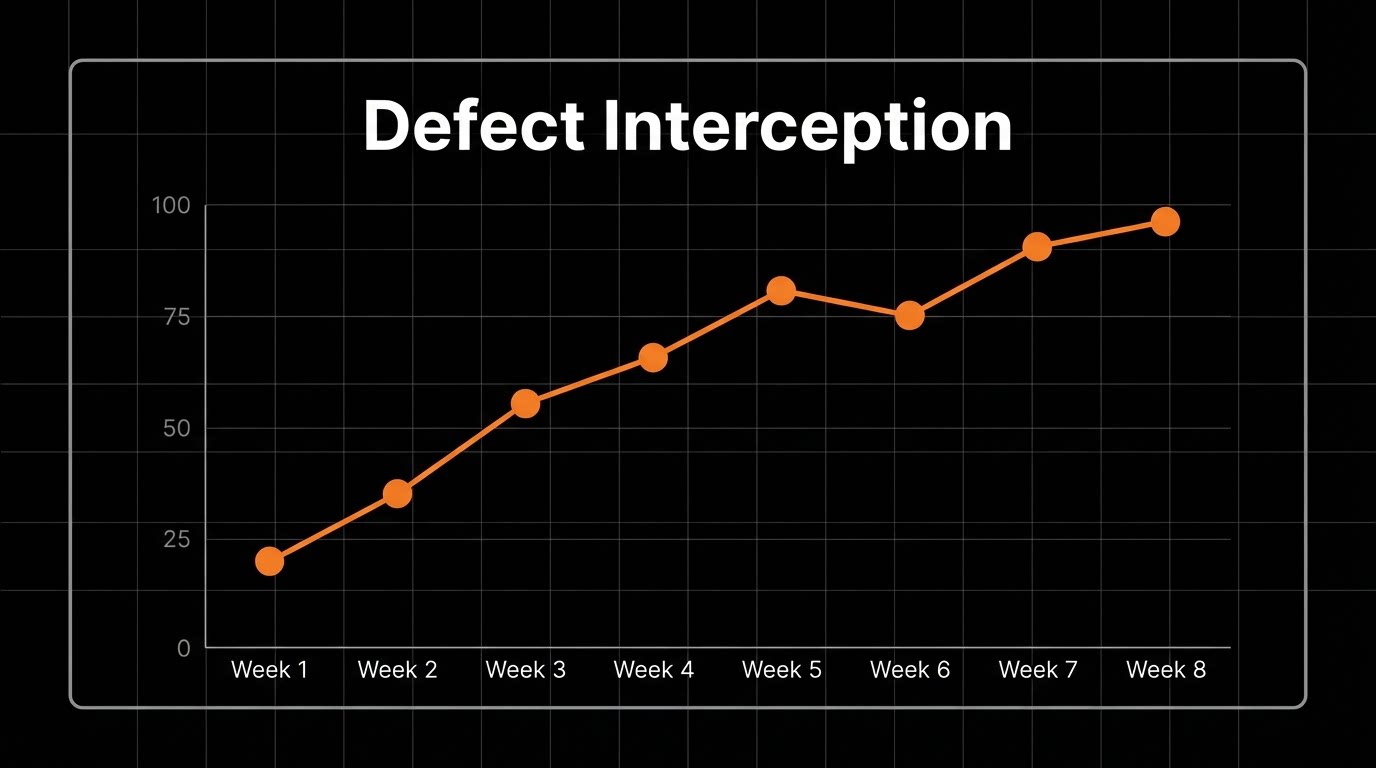
There’s a metric we track internally that doesn’t appear on most QC dashboards: Defect Escape Rate — the percentage of defective units that clear inspection and reach the end customer.
Our current sustained rate is 0.91%. Industry average for standard 3PL visual inspection sits between 3.1% and 4.8%, based on return rate data across comparable fulfillment operations.
The gap between 0.91% and 3.1% is not a technology gap. We’re not using equipment unavailable to other providers. The gap is architectural — it comes from treating QC as a system rather than a checkpoint.
Use this as a diagnostic filter for your current operation:
- If you have no Golden Sample protocol, every new batch from your supplier is an unverified variable.
- If your WMS doesn’t auto-flag Non-Saleable status across all channels on defect detection, you are selling products you haven’t approved.
- If your dimensional variance threshold isn’t defined in writing, “within spec” means whatever the factory decides it means that week.
- If your electronics pass a 10-second power-on test but not a 120-second stability test, you’re shipping intermittent failures.
- If your return rate is above 1.8%, the defect escape is already happening downstream.
At 80 orders per day, a 3.1% defect escape rate generates approximately 2–3 problem shipments daily. Over a month, that’s 60–90 return or refund events — before accounting for the review damage that doesn’t convert into a formal dispute but still affects your store’s conversion rate.
None of the interventions described in this guide are complicated. They require consistency, not brilliance. The architecture is the intervention.
For a technical assessment of your current SKU inspection parameters, review our Quality Check service or contact our fulfillment team directly.
Frequently Asked Questions
Who is liable if a defective unit passes your QC and reaches the customer?
Liability is distributed across the supply chain, not absorbed by a single party. Our QC protocol covers defects detectable at origin using the physical parameters defined in your SKU brief. For units that pass our inspection and fail post-delivery, our SLA distinguishes between two failure categories: transit damage (covered under carrier insurance, documented by our pre-shipment photo record) and manufacturing latent defects that weren’t surface-detectable at inspection (handled through our after-sales escalation workflow, with supplier chargeback documentation provided to the merchant). We don’t guarantee zero defect escape — no honest operator does. We guarantee a documented, auditable inspection process and a defined resolution path for every failure type.
What exactly is a Golden Sample and how often does it need to be updated?
A Golden Sample is a physically verified master unit — signed off by both the merchant and our QC team — against which all incoming batch units are calibrated. It’s not a photograph or a specification sheet. It’s a physical object stored in our facility. We require a mandatory refresh every 90 days, or immediately following any supplier-disclosed change in materials, manufacturing process, or component sourcing. If no disclosure is made but incoming batch weight deviates more than ±4g from the current Golden Sample baseline, we initiate a hold and request a factory audit before releasing any units to fulfillment.
Can your QC architecture handle stores with 100+ active SKUs?
Yes, but SKU counts above 80 active lines introduce routing complexity that requires a tiered inspection model rather than uniform 100% inspection across all SKUs. Our standard tiering: A-tier SKUs (top 20% by order volume) receive 100% unit-level inspection. B-tier SKUs are sampled at 32 units per batch using AQL 2.5 standard. C-tier SKUs receive dimensional and visual outer-packaging checks only. Merchants scaling past 80 active SKUs should request a QC architecture review before onboarding — the tiering logic needs to be mapped to your specific product mix, not applied as a generic template.
What’s the minimum order volume where engineered QC becomes cost-justified?
Based on our operational data, the break-even point where the cost of structured QC (inspection labor, Golden Sample maintenance, testing rig time) is offset by reduced return processing, re-shipment, and customer service costs typically falls between 35–50 orders per day. Below 35 daily orders, a rigorous supplier vetting process and regular sample orders often achieve comparable defect reduction at lower operational cost. Above 50 daily orders, unstructured QC reliably becomes the most expensive line item in your fulfillment operation — it just doesn’t appear as a single labeled cost.